

Career and Technical Education (CTE) classrooms across Texas are shaped by more than textbooks and standards—they are strengthened by real-world industry experience. CTE educators bring professional knowledge, technical expertise, and practical insight from their careers into the classroom, helping students develop the skills needed for meaningful, high-demand careers. By connecting industry practices with classroom learning, these educators prepare students to succeed in postsecondary education, training programs, and the workforce.
Many Texas CTE teachers did not begin their careers in education. They began in hospitals, businesses, construction sites, kitchens, technology firms, and skilled trades. What makes CTE unique—and essential—is that it bridges the gap between industry and education, enabling professionals to translate their knowledge into powerful learning experiences for students. This article examines how Texas CTE teachers use real-world skills to support students.
Why Real-World Experience Matters in CTE
CTE programs are designed to reflect the realities of the workforce. Students are not only learning academic concepts; they are developing technical skills, professional behaviors, and problem-solving strategies they will carry into postsecondary education, training programs, or directly into the workforce.
Educators with industry experience bring authenticity to instruction. They understand current practices, expectations, and challenges within their fields, and they can answer the question students often ask: “When will I actually use this?”
Industry experience strengthens CTE classrooms by:
- Connecting instruction to real-world applications
- Providing relevant examples and scenarios
- Modeling workplace professionalism and communication
- Preparing students for industry standards, certifications, and expectations
In CTE, professional experience is not a barrier to teaching—it is a foundational asset.
Translating Industry Skills Into Classroom Practice
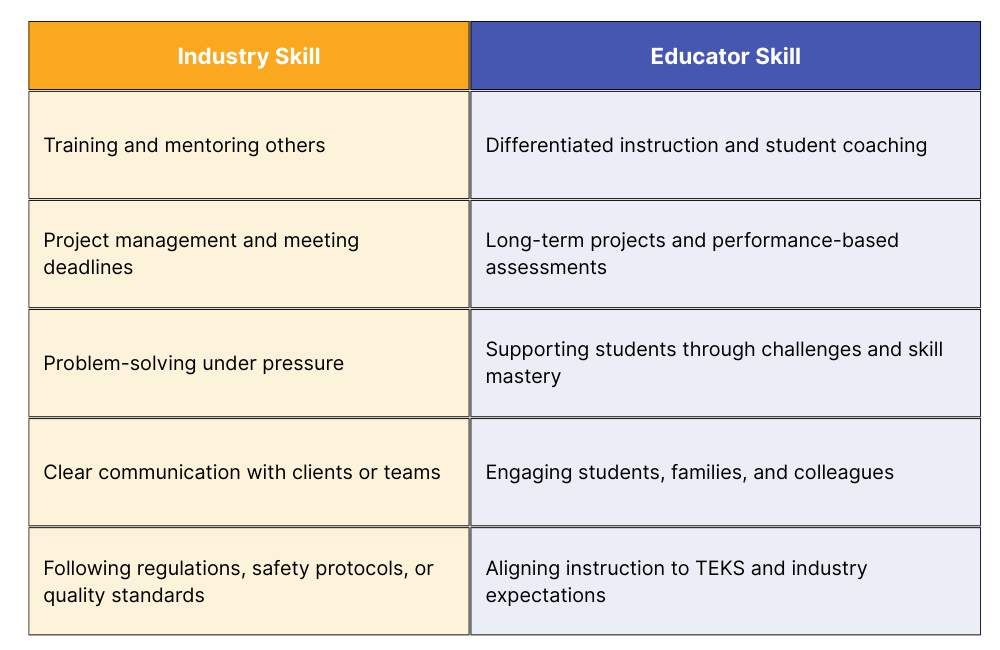
Many professionals considering teaching may not immediately recognize how their skills transfer to the classroom. In reality, overlap is significant. Industry professionals already demonstrate many of the core competencies of effective educators.
- Training and mentoring others → Differentiated instructions and student coaching
- Project management and meeting deadlines → Long-term projects and performance-based assessments
- Problem-solving under pressure → Supporting students through challenges and skill mastery
- Clear communication with clients or teams → Engaging students, families, and colleagues
- Following regulations, safety protocols, or quality standards →Aligning instruction to TEKS and industry expectations
These skills allow CTE teachers to design instruction that is rigorous, relevant, and responsive to student needs.
The Breadth of Career and Technical Education in Texas
Texas offers a wide range of CTE certification pathways aligned to the state’s diverse workforce needs. CTE programs reflect the reality that students have many postsecondary options—and many definitions of success.
CTE pathways include, but are not limited to:
- Health Science
- Business, Marketing, and Finance
- Information Technology and Computer Science
- Architecture and Construction
- Manufacturing, Welding, and Skilled Trades
- Hospitality, Culinary Arts, and Tourism
- Transportation, Distribution, and Logistics
- Arts, Audio/Video Technology, and Communications
- Education and Training
If an industry exists in Texas, there is likely a CTE pathway that prepares students to enter that field. This opens the door for professionals from varied professional backgrounds to make a meaningful impact in education.
Making a Difference Beyond Technical Skills
CTE teachers do more than teach technical content. They bring purpose, relevance, and real-world perspective into their classrooms. hear from a few ESC Region 13 Educator Certification Program (ECP) alumni as they reflect on how their industry experience shaped their teaching and their impact on students.

“The ECP program truly helped to give me the tools that I needed to not only survive my first year as a teacher coming from the construction industry, but to thrive and to be able to turn my classroom into an enjoyable setting. This allowed me to get the students even more excited and engaged in the project of building the Habitat for Humanity house.”
Trevor Hust, Construction Technology Teacher in Lubbock ISD
“My hope is that every classroom I enter becomes a space where purpose is ignited, confidence is built, and futures are forever changed.”
Dawn N. St. Julien, Business Statistics and Career Prep Teacher in Beaumont ISD


“Everyone’s journey into education looks a little different, and that’s the beauty of it. We each bring our unique experiences, perspectives, and strengths into the classroom, but at the core, we’re all working towards the same goals: building strong student-teacher relationships, fostering student success, and cultivating creative, inclusive classroom cultures.”
Sherita Harmon, Health Science teacher in Alief ISD
“Last year was my first time teaching my FAVORITE class, Anatomy and Physiology! Our Azle HOSA Chapter hosted approximately 400 area 5 HOSA members for the Fall Leadership Conference and learned from our local healthcare professionals and college health science programs.”
Jimmy Rider, Health Science teacher in Azle ISD

Ready To Explore Your Pathway Into Teaching?
If you are interested in learning more about the teacher certification process, including eligibility requirements and next steps, you can explore this resource: How to Become a Certified CTE Teacher in Texas
So, if you’re ready to turn your industry experience into a Texas teaching career— let’s get started together.
- Website: teach.esc13.net
- Email: ecp@esc13.txed.net
- Phone: 512-919-5366
Celebrating CTE Professionals and Real-World Skills
Career and Technical Education Month is celebrated every February to recognize the educators who bring industry, innovation, and opportunity into Texas classrooms. Their work strengthens communities, supports workforce development, and prepares students for success in an ever-changing economy. We continue to celebrate these educators beyond a single calendar month.
If you have ever considered how your professional experience could make a difference beyond your industry, CTE may be the bridge between what you know and who you can impact.
Your skills matter. Your experience matters. And in CTE classrooms across Texas, they are shaping the future.

Amy is the Coordinator for the Education Certification Program at ESC Region 13.



Add comment