

During a recent interview, Anna Warren, a veteran school leader and principal coach in Central Texas, explained that principals have always managed complex information. “As a leader, you’re getting information from so many people, and you need to decide what am I going to do with that? Does this go on my plate or someone else’s plate? Either way, as the principal, you still have to deal with it.”
But what does it mean to lead a school in an age when communication never turns off? Anna went on to reflect that technology has completely reshaped the immediacy and intensity of that flow. The work has not necessarily become more demanding, but it reaches leaders faster, louder, and through more channels than ever before. And each piece still requires the decision: Is this mine to act on, someone else’s to handle, or something I simply need to be aware of?
The speed of communication is now one of the biggest challenges that school leaders face, and without systems to manage the constant stream of information, leaders can quickly slip from intentional decision-making into a state of survival mode. Let’s explore how to restore clarity, protect your time, and build sustainable habits for leadership in a world of immediacy.
Effective Schools Framework Connection
The content of this blog supports ESF Lever 1: Strong School Leadership and Planning
Why Time Management Matters More Than Ever
When communication comes in nonstop through emails, texts, Remind messages, Teams pings, radio calls, and social media alerts, leaders often find themselves responding reactively rather than strategically. Over time, this creates:
- Decision fatigue
- Interrupted thinking and constant task switching
- Reduced time for coaching, instruction, and relationships
- Feelings of never catching up
- Burnout from being overly accessible
As Anna highlighted, today’s principals need strong systems to keep their work manageable—systems for capturing information, organizing it effectively, and determining what truly requires their time and attention.
Want actionable insights and strategies for your campus? Sign up for the Campus Leadership Newsletter and get the newest Practical Principal content straight to your inbox.
A System for Time Management: The Eisenhower Matrix
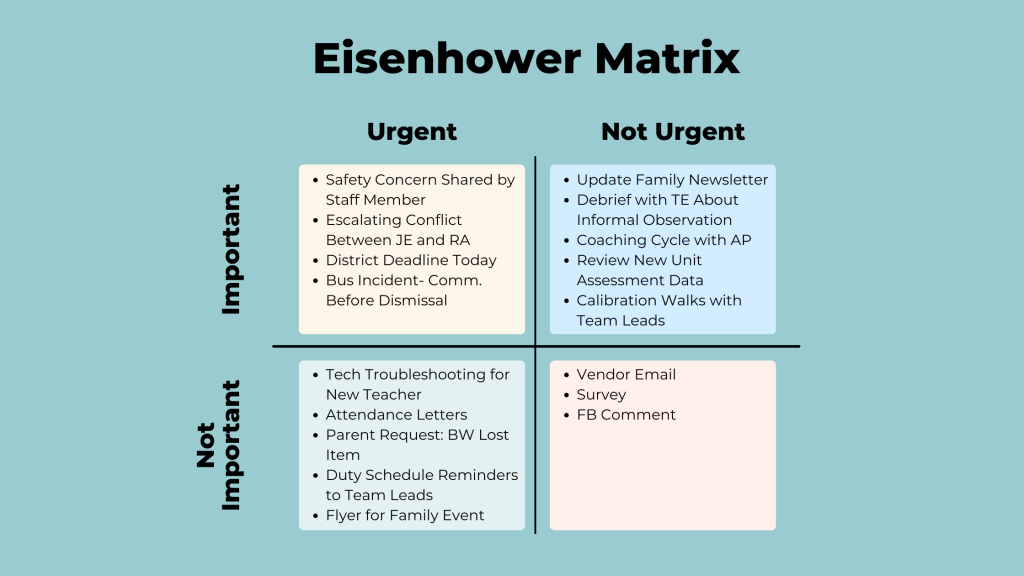
The Eisenhower Matrix enables leaders to categorize communication and tasks based on their urgency and importance, creating a visual map for informed decision-making and effective prioritization.

For school leaders, the matrix becomes a powerful filter. It helps answer:
- What requires MY immediate attention?
- What requires my leadership?
- What can be passed to the team? Who can I share this urgent work with?
- What does not need attention at all?
FREEBIE: Download your free Eisenhower Matrix template for school leaders. A ready-to-use, customizable tool to help you organize communication, strengthen time management, and delegate effectively.
Setting Boundaries in a World that Doesn’t Stop
Let’s address the elephant in the room.
Alongside time management systems, leaders need boundaries. Technology has made administrators accessible 24 hours a day. But availability is not the same as effectiveness.
Boundaries, both internal and external, help school leaders conserve energy, maintain clarity, and be their best selves. They communicate expectations to staff, families, and even to themselves about how and when you respond. The decision by school leaders affects hundreds of people every day, so it’s essential to respond effectively.
Because of this, it’s essential to establish a few guidelines for yourself to ensure you’re communicating as your best self. Some ideas you might consider are:
- Set specific times to check email instead of keeping the inbox open all day
- Use office hours for parent communication and communicate them clearly
- Turn off notifications outside of essential channels, such as safety
- Empower your team to field concerns that do not require your involvement
- Use out of office responses during evenings or weekends to set expectations
- Protect time for instructional leadership with scheduled no-meeting blocks
Remember, boundaries are not barriers. They are commitments to showing up fully for the work that truly matters. And the more you model this for your staff, the more they can embrace the idea and incorporate it into their own work as well.
Guiding Questions to Help with Time Management and Setting Boundaries
As communication comes in, use these questions to guide your decision about what to do with it:
- Does this require action or simply acknowledgment?
- Is this urgent because of timing or because of emotion?
- Am I the right person to handle this, or is someone else equally or better suited?
- What is the real impact if I respond later?
- Does responding immediately align with my leadership priorities or interrupt them?
- What boundary would help prevent this type of overwhelm in the future?
You cannot slow the speed of communication in the world around you, but you can build systems and boundaries that help you navigate it with clarity and confidence. Time management is not about squeezing more into the day. It is about reclaiming your attention for the leadership work that matters most. This puts you back in the seat to control what you can and maintain your campus’s momentum toward the work that really impacts student learning and success each day.

Natalie is an Educator Evaluation and Leadership Administrative Specialist at ESC Region 13.



Add comment