

Implementing a Teacher Incentive Allotment (TIA) system is a significant milestone for a district, but the work doesn’t stop once the system is approved. As your district continues its TIA journey, you may find opportunities to strengthen existing practices and include additional teaching assignments.
If your district is considering expansion, the question isn’t just, “Are we ready to expand?” It’s also, “How can we expand in a way that supports meaningful student growth?”
Start by Identifying Opportunities for Expansion
Before making changes, take a closer look at your current TIA system. Which eligible teaching assignments are already included? Which are not? Could you expand existing teacher categories or add new ones?
For example, your district may have an established TIA system for core content teachers but not yet include Fine Arts, Career and Technical Education (CTE), interventionists, or special education teachers.
Identifying these opportunities is an important first step. However, expanding your system requires more than identifying additional teaching assignments. You’ll also need to determine which student growth measures fit each course and assignment.
Match Teaching Assignments With Appropriate Student Growth Measures
TIA allows four student growth measures: portfolios, Student Learning Objectives (SLOs), value-added measures (VAM), and pretest/posttest assessments.
One of the most important decisions you’ll make during expansion is selecting student growth measures that accurately reflect the content and skills being taught.
For example, portfolios may be a good fit for performance-based courses such as Band or Theater. Pretest/posttest assessments may work well for courses with established, standards-aligned assessments.
The goal is to select measures that provide meaningful evidence of student growth while remaining practical and sustainable for your district.
Use a Decision-Making Framework to Guide Expansion
Once you’ve identified potential teaching assignments and student growth measures, how do you decide where to begin?
Use these questions to guide your district’s expansion decisions:
- Which teaching assignments are not yet included in your TIA system?
- Are student growth measures already in place for these assignments?
- Do the measures align with teacher practices and course standards?
- Do the measures provide meaningful evidence of student growth?
- What resources will your district need to implement these measures?
Working through these questions can help your district determine which teaching assignments are ready for expansion and which require additional planning.
What Could This Look Like in Practice?
Consider a district interested in expanding its TIA system to include elementary Fine Arts teachers. The district identifies 30 elementary art teachers who are not currently included in its system. However, it doesn’t have an established student growth measure for these assignments.
Rather than immediately selecting an assessment, the district’s TIA committee explores its options. Could a pretest/posttest assessment accurately measure student growth in art? Would a portfolio better reflect the skills students develop throughout the year? What training, resources, and processes would the district need to implement either option?
After evaluating these considerations, the district may determine that additional planning or a pilot year is necessary before including these assignments in its system.
Your district can apply this same decision-making process to other teaching assignments. Taking time to evaluate your options helps ensure that expansion is intentional and supported by a clear plan.
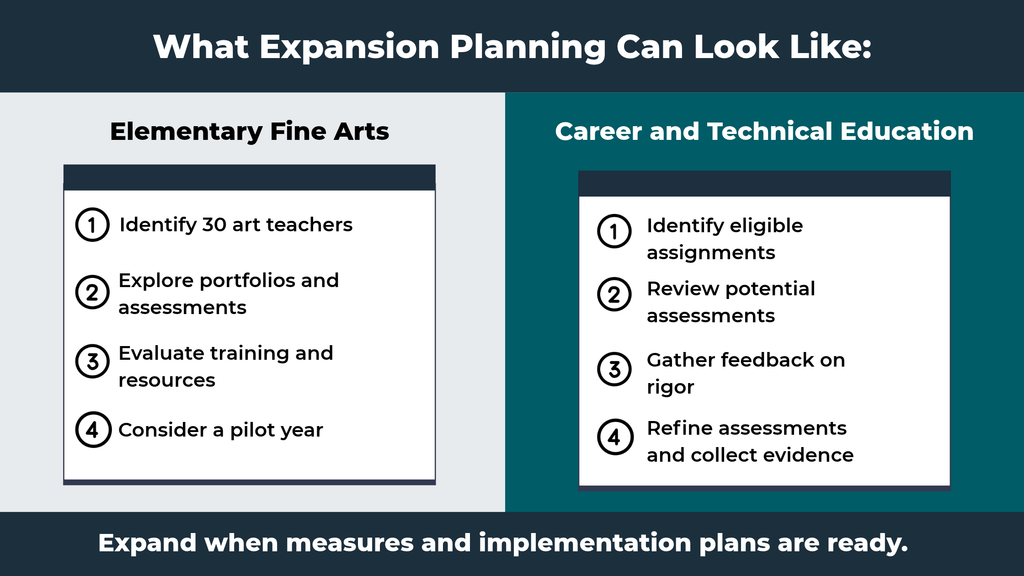
Another example involves a district interested in adding CTE courses to its TIA system. The district has identified eligible teaching assignments and potential pretest/posttest assessments, but the TIA committee wants stakeholder feedback before deciding.
The committee gathers input from CTE teachers, campus administrators, and instructional leaders. Through these conversations, the district discovers that its proposed assessments may not be rigorous enough to provide valid evidence of student growth.
With this information, the district can work to develop more effective assessments. It can then collect data to evaluate the assessments’ rigor and effectiveness before incorporating them into its TIA system.
Gathering stakeholder feedback and evaluating assessment options before expanding can help districts make stronger, more informed decisions.
Expand With Purpose
Expanding your TIA system creates opportunities to recognize more teachers, strengthen district practices, and support teacher recruitment and retention.
However, successful expansion isn’t measured solely by the number of teaching assignments you add. It’s also about ensuring each addition is supported by appropriate measures that provide meaningful evidence of student growth.
By taking a thoughtful, strategic approach, your district can build a TIA system that supports teachers and recognizes their impact on student learning.

Allison Yedinak
Allison is a TIA Assessment Specialist at ESC Region 13.



Add comment