

Fidelity feels like the latest buzzword in education. We use it to talk about whether teachers are implementing the curriculum correctly, following the PLC process, or using a new instructional strategy as intended. But in our rush to ensure fidelity, have we stopped asking the most important question: What are we trying to be faithful to?
What Does Fidelity Mean in Education?
Fidelity in education refers to implementing instructional programs, strategies, and processes as intended. However, effective implementation also requires understanding the purpose behind those practices and examining whether they support student learning.
Fidelity easily becomes compliance as tasks are seen as checkboxes:
- HQIM: Teachers complete the lesson as written, but the conversation focuses on whether they followed every step rather than the lesson’s intended learning, rigor, and coherence.
- PLCs: Teams complete the agenda, review the data, and fill out the action plan, but they leave without developing a shared understanding of what students need next.
- Instructional strategies or programs (think the 5E Model or the Fundamental 5): Teachers use the required routine, but no one examines whether it is serving its intended purpose.
The problem isn’t consistency itself: shared processes and clear expectations matter. The question is whether those processes are helping us achieve their intended purpose. Are we using PLC time to improve student learning? Are we protecting the rigor and coherence of the curriculum? Are our instructional strategies making a difference for students? Compliance asks, “Did we do it?” Fidelity to purpose asks, “Did we preserve what makes it valuable?”
How can coaches support fidelity to HQIM, PLC processes, and instructional initiatives without reducing implementation to compliance?
Fidelity in Education: Program Compliance vs. Purpose
Steve Barkley has been exploring the concept of fidelity for a while, so we invited him to speak at our Instructional Coaching Partnership (ICP) Series with Fidelity to Purpose: Coaching Curriculum Change.
In Barkley’s recent podcast, “Coaching Around the Fidelity Question,” he explores the tension coaches face between compliance and shared responsibility for student success. Successful implementation requires vulnerability and a willingness to learn. Teachers must be willing to try new practices, coaches must facilitate reflection and collective learning, and leaders must acknowledge they don’t have all the answers.
Teachers are professionals, not simply implementers of a program. Professional expertise involves more than knowing how to follow a set of directions. It requires teachers to make decisions, study student responses, reflect on what is working, and determine what to do next. When fidelity conversations focus only on whether teachers followed the program correctly, we risk diminishing the very professional judgment that can help make implementation successful.
Understanding Teacher Resistance to Change
A teacher’s resistance doesn’t necessarily mean they don’t want to change. They may be trying to protect something they value. When a teacher is reluctant to implement something as directed, explore what may be beneath the behavior:
- Concern that the lesson won’t meet students’ needs.
- Previous experiences with initiatives that disappeared or didn’t deliver.
- A sense of professional expertise or autonomy being threatened.
- Genuine questions about how the new approach will improve learning.
A possible coaching question around protection:
“I hear your concern about this lesson. What do you want your students to experience or learn, and how might we protect that while staying true to the intent of the curriculum?“
From Curriculum Police to Thinking Partner
Steve Barkley argues that coaches can find themselves in two difficult positions during curriculum change. We don’t want to become the curriculum police, monitoring whether teachers follow every step. But we also don’t want to become curriculum apologists, defending every part of the program without considering what teachers and students are experiencing. Barkley offers another option: become a thinking partner. Help teachers examine what happened, connect it to the intended learning, and determine what to investigate or try next.
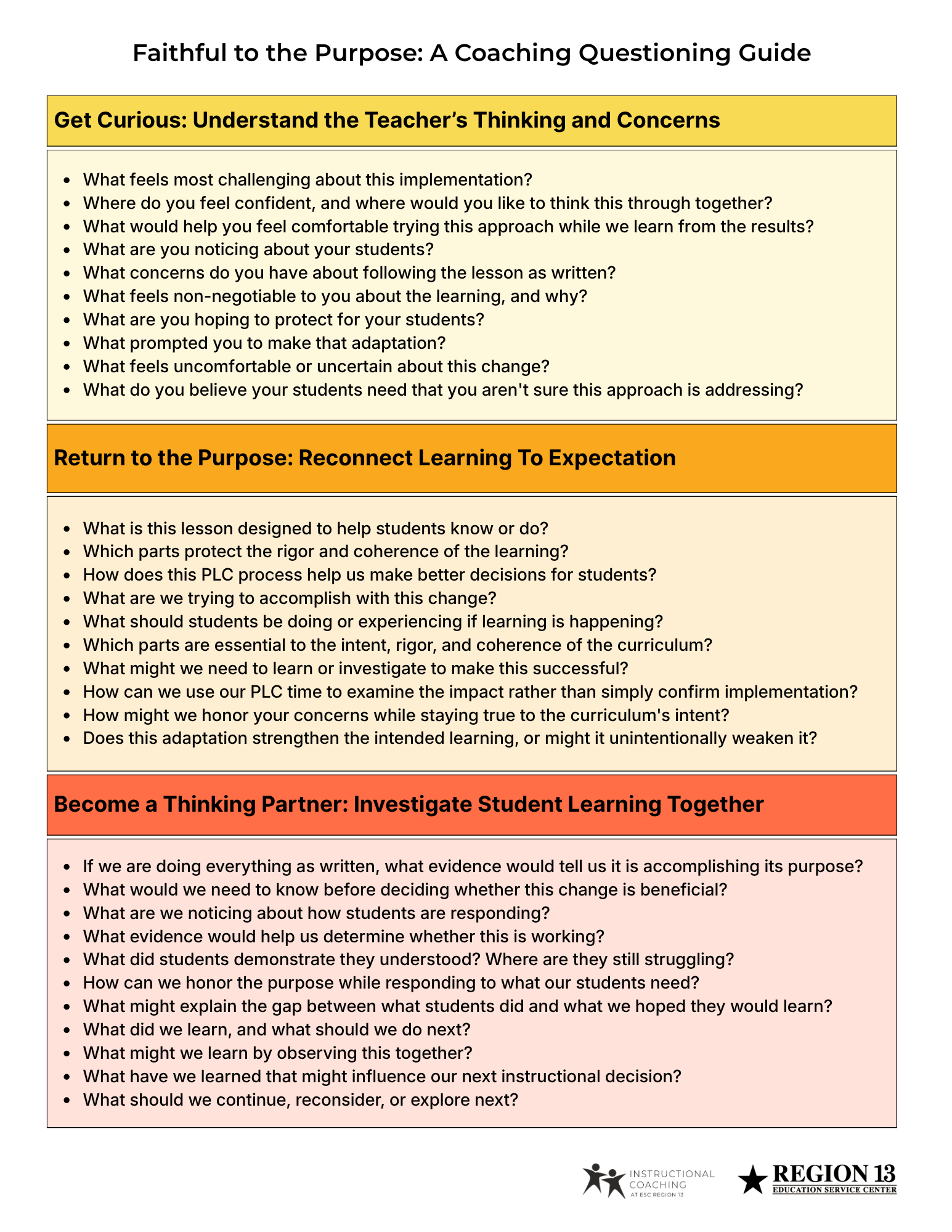
The following moves are not Barkley’s framework, but they are informed by his ideas. Check out the included resources to discover more of Barkley’s take on fidelity.
Move 1: Get Curious Before Making Assumptions
Barkley writes in his blog “Before You Label It Resistance, Get Curious,” “Approaching resistance with curiosity may begin with the questions we ask ourselves before we ever respond” (Barkley, 2026). Barkley’s point is that a coach needs to understand a teacher’s perspective before assuming resistance. Explore a teacher’s beliefs, concerns, and reasoning before labeling actions or statements as unwilling.
Questions to explore their thinking:
- What feels most challenging about this implementation?
- What are you noticing about your students?
- What are you concerned might happen if we follow the lesson as written?
Keep in mind that curiosity isn’t just asking questions: it’s listening to understand the teacher’s experience before responding. If resistance is present, pause, listen, and acknowledge the thinking behind it.
Move 2: Return to the Purpose
Work with teachers to connect the expectation to its intended impact. In HQIM, PLC, and instructional strategies, explore how teachers are trying to improve student learning. In a recent Instructional Coaching Partnership (ICP) session, Barkley suggested that local coaches explore four questions with teachers:
- What learning outcomes is the curriculum meant to advance?
- What must students do and experience to produce that learning?
- What teacher actions could support those student behaviors?
- What might the teacher need to learn or investigate?
These questions give coaches a way to move from program implementation to instructional thinking with teachers. The focus is on what students should be learning and experiencing, not whether a teacher completed the lesson as written.
Move 3: Become a Thinking Partner
Reflect with the teacher on what students actually experienced and learned. Work together to notice student responses, make sense of the evidence, and determine what to try or investigate next. The goal is to connect instructional decisions to student learning—not simply to check whether implementation happened.
Questions to examine evidence and reflect on results:
- What evidence would help us determine whether this is working?
- How can we honor the purpose while responding to what our students need?
- What did we learn, and what should we do next?
Move 3 brings the first two moves together: understand the teacher’s perspective, reconnect to the purpose, and examine whether the instructional approach is accomplishing it.
Why Fidelity to Purpose Matters in Education
We don’t need to stop talking about fidelity. We need to be more intentional about what we’re asking educators to be faithful to. When fidelity becomes the primary measure of implementation, it’s easy to mistake following the process for accomplishing the purpose.
ESC Region 13 Can Help
For more ideas and questions to use in your coaching, download the “Faithful to the Purpose: A Coaching Questioning Guide,” created by theESC Region 13 Instructional Coaching team.
Our team is here to support you in all aspects of professional growth. Connect with a team member if you have questions or needs. Subscribe to our newsletter for the latest updates and resources in instructional coaching. Visit our website for professional development opportunities, services, and products. Check out the ESC Region 13 blog for more instructional coaching and strategic instruction-related articles.
Resources:
Barkley, S. (2026, April 26). Fidelity to the program or fidelity to the purpose? Steve Barkley Education Consultant. https://barkleypd.com/blog/fidelity-to-the-program-or-fidelity-to-the-purpose/
Barkley, S. (2026, May 14). Podcast: Coaching around the fidelity question. Steve Barkley Education Consultant. https://barkleypd.com/blog/podcast-coaching-around-the-fidelity-question/
Barkley, S. (2026, September 4). Before you label it resistance, get curious. Steve Barkley Education Consultant. https://dev.barkleypd.com/blog/before-you-label-it-resistance-get-curious/

Jennifer Hoober is an Education Specialist for the Instructional Coaches team at ESC Region 13.



Add comment