

You walk into a professional learning community (PLC) and teachers are busy. Someone is pulling up the upcoming lesson from the high-quality instructional material (HQIM) dashboard. Someone else is sharing a new resource they have just discovered. The team discusses pacing, makes copies of an assessment, and decides who will bring what next week.
It feels productive. But when the meeting ends, you wonder: What did the team learn together?
PLC teams can spend significant time planning, preparing materials, organizing, and coordinating. Although those activities are important, they don’t automatically make the time a PLC.
How can instructional coaches support PLCs in moving from completing tasks to engaging in collective learning?
A PLC isn’t valuable simply because teachers meet; it is valuable because teachers learn together in ways that improve student learning.
How Can Coaches Shift PLCs from Tasks to Collective Learning?
One simple shift can change the conversation.
Instead of asking, “What do we need to get done today?” ask, “What do we need to learn together to improve student learning?”
There are four areas of learning that can help teams answer that question:
| Students | Curriculum | Instruction | Impact |
|---|---|---|---|
| What are students understanding? | What are students expected to know and do? | What teacher moves are likely to help? | Did what we tried work? |
| Where are they struggling? | What is most important? | What might we do differently? | What evidence tells us that? |
| What misconceptions are showing up? | Where is the rigor? | What is worth trying together? | What do we do next? |
These four areas give teams something to learn about. Still, having the structure isn’t the same as doing the learning. A PLC can be doing something that looks very PLC-ish without actually engaging in collective learning.
For example: the team is looking at student work. Why? Are teachers sorting papers? Assigning scores? Identifying which students passed? Or are they trying to learn something together?
The coach can support the team in moving from the activity to the learning question:
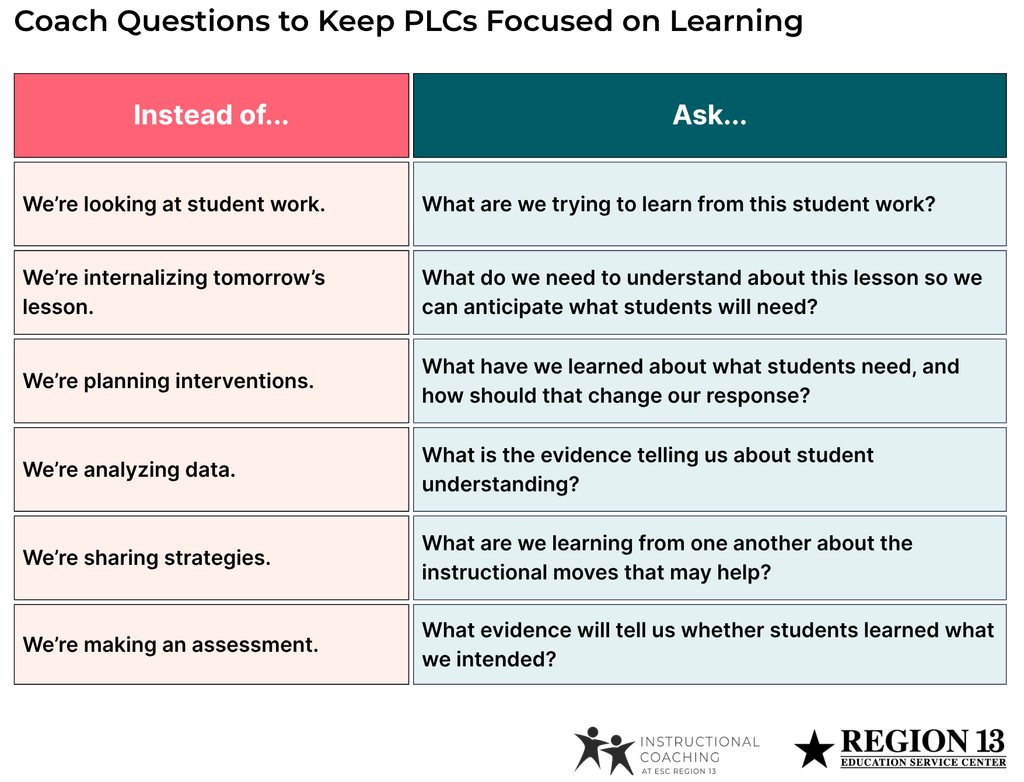
- Instead of: We’re looking at student work.
Ask: What are we trying to learn from this student work? - Instead of: We’re internalizing tomorrow’s lesson.
Ask: What do we need to understand about this lesson so we can anticipate what students will need? - Instead of: We’re planning interventions.
Ask: What have we learned about what students need, and how should that change our response? - Instead of: We’re analyzing data.
Ask: What is the evidence telling us about student understanding? - Instead of: We’re sharing strategies.
Ask: What are we learning from one another about the instructional moves that may help? - Instead of: We’re making an assessment.
Ask: What evidence will tell us whether students learned what we intended?
Coach questioning keeps the PLC focused on the learning. This can also make the team’s learning more visible.
Before a PLC begins an activity, the coach can ask, “What are we hoping to learn by doing this?” Another great, follow-up question: “What will we do with what we learn?” Try our Coach’s Conversation Guide for some more ideas and great questions to try.
When teams make that learning explicit, a routine PLC activity can become a cycle of collective inquiry. For example:
Activity: Look at student writing samples.
Learning: We notice that students can identify evidence but struggle to explain how the evidence supports their thinking.
Action: We explicitly model that connection and collect another sample.
Next Week: We return to the evidence and determine whether the response helped.
This cycle can happen around student work, assessment data, instructional strategies, or curriculum. But the shift from activity to learning becomes especially important when the work itself is required.
How Can PLCs Use HQIM to Improve Student Learning?
For many Texas teachers, PLC time now includes significant work around HQIM, specifically internalization. Internalization can be part of meaningful PLC work, yet it shouldn’t be the defining act of PLC.
If teachers leave knowing the lesson better but not their students better, the team may have completed a task without engaging in collective learning.
This is an example of starting with the activity. It started with, “We need to internalize the lesson.” Instead, teams can consider the question: What do we need to understand about this lesson and our students in order to answer the Four Critical Questions?
The Four Critical Questions Guiding PLCs with action-oriented inquiry (DuFour, et al., 2016)
Q1: What do we want students to learn?
HQIM internalization can help the team understand the learning goal rigor, lesson arc, representations, and anticipated misconceptions.
Q2: How will we know if they learned it?
The team discusses assessment and student evidence in the HQIM.
Q3: What will we do if they haven’t learned it?
The team considers instructional response using HQIM and supplemental materials.
Q4: What will we do if they already know it?
The team considers appropriate extensions to respond to students who are ready for more.
When the curriculum is an object of collective inquiry, it carries more meaning than something teachers are preparing to deliver. And the coach then has the opportunity to change some common internalization questions into high-impact PLC questions:
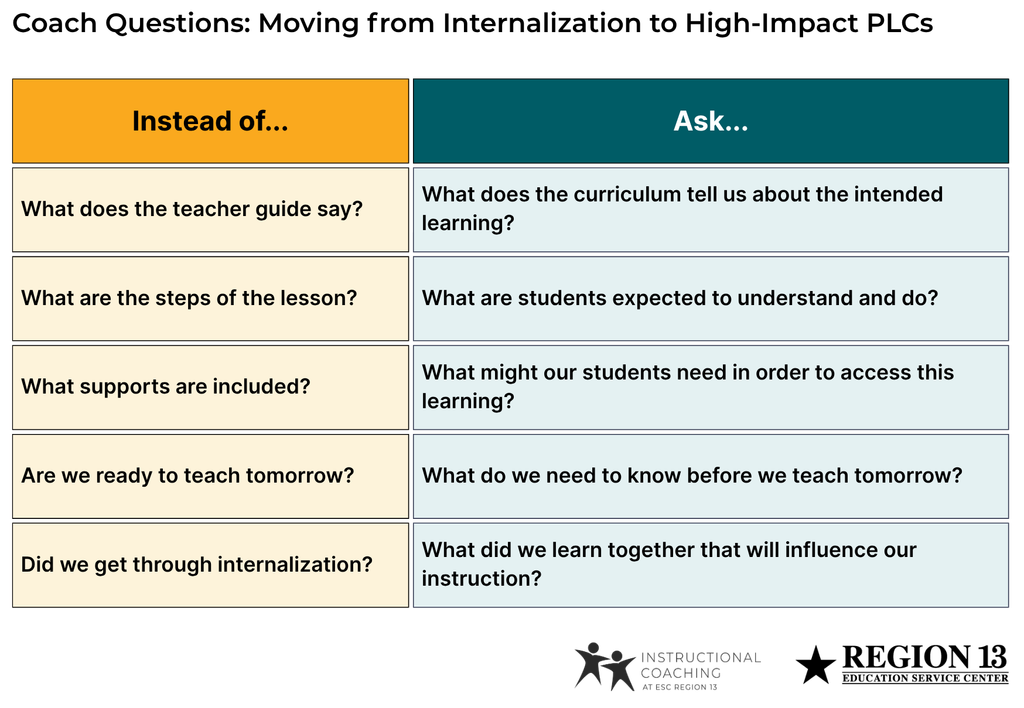
- Instead of: What does the teacher guide say?
Ask: What does the curriculum tell us about the intended learning? - Instead of: What are the steps of the lesson?
Ask: What are students expected to understand and do? - Instead of: What supports are included?
Ask: What might our students need in order to access this learning? - Instead of: Are we ready to teach tomorrow?
Ask: What do we need to know before we teach tomorrow? - Instead of: Did we get through internalization?
Ask: What did we learn together that will influence our instruction?
Make Collective Learning the Purpose of Every PLC Meeting
Picture that same PLC again—someone pulling up the lesson, someone sharing a resource, pacing decisions being made. Only this time, before the team dives in, someone asks: What are we hoping to learn today? The tasks don’t disappear. But now they’re in service of something bigger than getting through the agenda. That’s the shift: not eliminating the doing, but making sure we’re learning while we do it.
ESC Region 13 Can Help
The ESC Region 13 Instructional Coaching team created, “Is Your PLC Learning Together? A Coach’s Conversation Guide,” to help PLCs ask questions, learn what to listen and look for, and apply thoughtful coaching questions to the situation. Download your copy of the guide.
Our team is here to support you in all aspects of professional growth. Connect with a team member if you have questions or needs. Subscribe to our newsletter for the latest updates and resources in instructional coaching. Visit our website for professional development opportunities, services, and products. Check out the ESC Region 13 blog for more instructional coaching and strategic instruction related articles.
Coaching Questions Resources
Download your own copy of the Coach Questions to Keep PLCs Focused on Learning.
Download your own copy of the Coach Questions: Moving from Internalization to High-Impact PLCs.
Footnote:
DuFour, R. DuFour, R., Eaker, R., Many, T.W., & Mattos, M. (2016). Learning by doing: A handbook for professional learning communities at work (3rd ed.). Solution Tree Press.

Jennifer Hoober is an Education Specialist for the Instructional Coaches team here at Region 13.



Add comment