

As instructional coaches, we often live in the space between system expectations and teacher autonomy. We may be asked to support the implementation of high-quality instructional materials (HQIM), participate in campus walkthroughs, or help teachers move toward a district or campus priority. At the same time, we know that effective coaching depends on teacher agency, trust, and professional judgment. So what happens when the work isn’t optional? How do we maintain teacher autonomy when we are supporting something teachers didn’t choose?
How Well Do You Know Your Teachers
In Steve Barkely’s recent blog, “Coaching Begins with Knowing: Keep Finding Out,” Barkley ponders how intimately an instructional coach needs to know a teacher to coach them well. His answer is that coaches need to continually get to know the professionals they work with—not simply know the teacher’s stated goal, but understand the less visible things underneath it: confidence, previous experiences, concerns, expertise, and uncertainty.

This has us wondering if perhaps “finding out” is a place to start when autonomy and compliance collide. When we cannot give teachers autonomy over the initiative itself, we can protect their agency by being committed to continually finding out.
Find Out About Teacher Beliefs
Teacher: I don’t understand why I have to use this lesson. I know my students, and this isn’t going to work.
The initial coaching response is to explain the rationale for HQIM. But when we commit to finding out, we search for what is underneath that statement:
- What has the teacher experienced with curriculum implementation in the past?
- What specifically about the lesson concerns them?
- What do they know about their students that they believe the curriculum doesn’t account for?
Finding out what is underneath a teacher’s concern or hesitation can help us understand whether we are addressing a misunderstanding, a genuine concern, or important professional knowledge that needs to be considered.
Find Out Before A Walkthrough
First and foremost, don’t participate in a walkthrough if you can help it. Walkthroughs create a challenge because the teacher did not initiate the data collection happening in their classroom. The danger is that we enter the walkthrough focused on what we want to see, rather than staying curious about what the teacher and students are experiencing.
If walkthroughs are inevitable in your context, prioritize scheduling a conversation beforehand. Before the walkthrough, you might ask:
- What are you working on right now?
- Is there something you’d like me to pay attention to?
- What would be useful for us to learn from the walkthrough?
Even if the walkthrough has a predetermined focus, you can still ask:
“What do you want to know about your students from this visit?”
Now the walkthrough becomes something the coach and teacher can learn from together rather than simply something done to the teacher.
During the debrief, instead of immediately saying, “I noticed that only three students participated…”
Start with, “What did you notice?”
Then, “What surprised you?”
“What matched what you expected?”
“What are you wondering about?”
“What might you want to find out next?”
These questions uncover the teacher’s perception, values, and more, and help the coach determine when to listen, probe, support, or challenge.
Agency Values Thinking
Perhaps our jobs as coaches aren’t always to give teachers more choices. Sometimes the job is to make sure that even when the choices are limited, we continue to understand the person doing the work.
So what can that look like in practice?
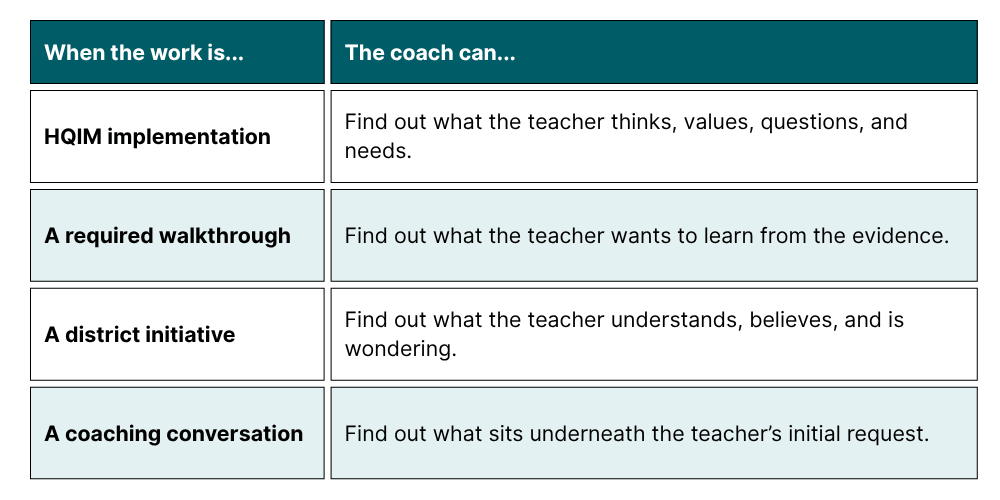
Keep Finding Out
As you work with teachers, remain curious and ask the question that helps you understand the teacher’s thinking right now:
- What are they concerned about?
- What are they confident about?
- What are they trying to protect?
While it’s inevitable to have tension between supporting a system priority and maintaining teacher agency, Barkley reminds us that coaching begins with knowing—and that knowing requires continually finding out.
The initiative, the walkthrough, or the curriculum may not be optional. But the teacher doesn’t have to become invisible in the process.
Keep asking. Keep listening. Keep finding out.
More Resources
ESC Region 13 Instructional Coaching is here to support you in your professional growth. Connect with any of our instructional coaches if you have questions or needs. Subscribe to our newsletter for the latest updates and resources in instructional coaching. Visit our website for professional development opportunities, services, and products. Visit the ESC Region 13 blog for more instructional coaching and strategic instruction related articles.

Jennifer Hoober is an Education Specialist for the Instructional Coaches team here at Region 13.



Add comment