

In our previous article, A Paraprofessional’s Guide to Working with Emergent Bilingual Students, we explored the foundations of supporting Emergent Bilingual (EB) students—from understanding the five stages of language acquisition and navigating the four distinct EB student profiles to applying targeted, actionable classroom scaffolds like cognates, recasting, and visual supports.
Building on those foundational strategies, this article moves from individual instructional techniques to the power of teamwork. The partnership between classroom teachers and paraprofessionals is one of the most effective leverage points in any school. When teachers and paraprofessionals move beyond simply sharing physical space and begin operating as a synchronized instructional team, EBs receive the targeted linguistic, academic, and socio-emotional support they need to thrive.
Steps For Building an EB Collaboration Model
Here is a practical, field-tested guide to building a seamless collaboration model that maximizes support for EB students.
1. Carve Out Time to Meet and Plan
Effective collaboration cannot happen on the fly. It requires deliberate, protected time for teachers and paraprofessionals to connect, discuss upcoming lessons, align on instructional strategies, and evaluate student growth.
During planning meetings, prioritize discussions around:
- Academic progress: Where are students grasping the content, and where are they stalling?
- Language acquisition: Is the student moving forward in their speaking, listening, reading, and writing domains?
- Linguistic supports: What specific language scaffolding will be used during the upcoming unit?
When both educators understand the “why” behind a lesson and track student growth together, instructional support becomes proactive rather than reactive.
2. Establish Clear Classroom and Team Routines
Emergent Bilinguals thrive in predictable environments. Structured routines create a sense of psychological safety, reducing cognitive overload so students can focus on language acquisition and content mastery.
Collaboration routines are equally vital for the adults in the room. Establishing clear operational expectations ensures both the teacher and paraprofessional understand their roles throughout the instructional cycle.
Field Note: Onboarding Mid-Year Arrivals
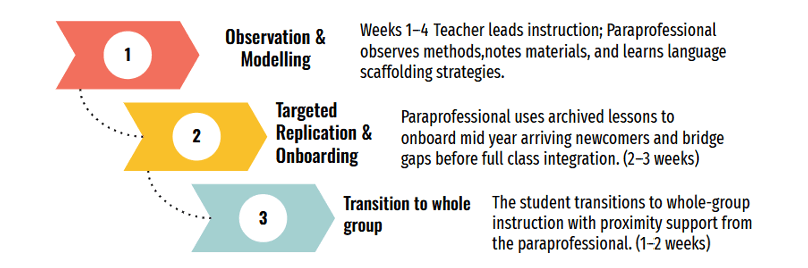
In a high school newcomer class, the teacher led instruction for the first four weeks while the paraprofessional observed, took detailed notes on instructional strategies, and cataloged the materials used. When new EBs arrived mid-year, the paraprofessional pulled them into targeted side-by-side sessions—replicating those foundational lessons from weeks one–four. Through ongoing progress discussions, the paraprofessional signaled exactly when the student was caught up and ready to transition smoothly into the main class flow.
3. Decide Who You Will Support and How
Before any lesson begins, both educators should have absolute clarity on student assignments and service delivery models. Ambiguity leads to lost instructional time.
Determine the support model based on student need and lesson design:
| Support Model | Primary Function | Best Used When |
|---|---|---|
| Direct Small-Group Instruction | Pulling a small group aside for targeted language or content intervention. | Reteaching core concepts, front loading vocabulary, or scaffolded guided reading. |
| Proximity & On-Demand Support | Circulating around EB students during whole-group instruction or independent work. | Providing real-time sentence frames, clarifying instructions, or checking for understanding. |
4. Discuss Available Materials and Accommodations
As the paraprofessional observes the teacher modeling instructional strategies, both partners should regularly evaluate the linguistic accommodations needed by the students.
Accommodation planning should focus on:
- Visuals & Graphic Organizers: Anchoring complex text with charts, images, and concept maps.
- Linguistic Supports: Implementing sentence stems, bilingual glossaries, word banks, and simplified text.
- Scaffolded Application: Adapting the level of support dynamically based on individual student language proficiency levels.
5. Build a Strategic, Data-Driven Schedule
To serve as many Emergent Bilinguals as possible, scheduling must be strategic and flexible. Rather than keeping support static, allocate paraprofessional time based on student density, subject difficulty, and real-time performance data.
- Map Student Needs: Identify which class periods contain the highest concentration of EBs, and which subjects present the steepest language barriers.
- Co-Design the Master Plan: Build the support schedule collaboratively between all teachers sharing paraprofessional time.
- Utilize Progress Milestones: Run student progress reports every three weeks. Use this data to dynamically redeploy EB paraprofessionals to the classrooms, subjects, or student cohorts that demonstrate the highest need at that moment.
6. Serve as an Advocate for EBs
Because paraprofessionals work in close physical and instructional proximity to students, they are often the first to spot subtle patterns, emerging talents, or hidden struggles.
Paraprofessionals are uniquely positioned to recognize:
- Unnoticed academic roadblocks or gaps in foundational knowledge.
- Extraordinary talents in problem-solving, art, or critical thinking that bypass language barriers.
- A student’s unspoken interest in athletics, fine arts, or Career and Technical Education (CTE) pathways.
Never hesitate to speak up. Active advocacy changes lives. Dedicated paraprofessionals who listen closely to their students have successfully championed newcomers into AP Mathematics courses, high school bands, and varsity athletic teams—opening doors that language barriers might otherwise have kept closed.
Conclusion
Supporting Emergent Bilinguals is a team effort. Teachers and paraprofessionals can build powerful classroom partnerships.
For questions about EB students or multilingual programs, contact the Multilingual Team at ESC Region 13. Subscribe to the multilingual newsletter and stay up-to-date on current information impacting your programs, dates, and news. You can also visit our webpage for professional development opportunities, resources, products, and more.
Read additional articles on the ESC Region 13 blog sharing practical ways to co-plan, communicate effectively, and maximize student success together.
Note: This article was published in November 2026. AI was used to support the writing; however, all information was verified by humans.
*The graphic was created by the author using AI and a Slidesgo template.

Ana Segulin
Ana Segulin is the Coordinator of Multilingual Support, Title III and Migrant Education at ESC Region 13.



Add comment