

Every educator knows the unwritten rule of school leadership: your master schedule is your true campus budget. It is not just a spreadsheet of names, rooms, and times. It is the definitive, legally binding reflection of your campus values, your instructional vision, and your commitment to student success.
When a master schedule is built purely as a logistical puzzle, student needs are compromised. High-achieving students are forced to choose between Varsity Band and AP Physics. Special education inclusion teachers jump across unrelated classrooms like pinballs. Novice teachers are buried under three different class preparations.
For Texas secondary principals, the stakes are even higher. Our schedules must balance local campus culture with strict Texas Education Agency (TEA) compliance metrics and legislative mandates.
If you are staring at a blank grid for the upcoming school year, step away from the software. Use this strategic guide to transform your scheduling process from a stressful chore into a powerful driver of student success.
The Non-Negotiable Texas Compliance Checklist
Before placing a single course on the grid, you must anchor your schedule around three critical state requirements. Failing to do so can result in costly compliance audits or lost accountability points.
1. The 450-Minute Teacher Planning Mandate
Under Texas Education Code § 21.404, every full-time classroom teacher is legally entitled to at least 450 minutes of planning and preparation time every two weeks. Furthermore, the state mandates that this time cannot be broken into tiny fragments; it must include a daily consecutive block of at least 45 minutes. When designing your master grid, these blocks must be fiercely protected from duty assignments or mandatory meetings.
2. STAAR & EOC Accelerated Instruction
State guidelines require targeted intervention for any student who does not achieve “Approaches Grade Level” or higher on STAAR or End-of-Course (EOC) exams. Successful Texas principals create a specific time for help, like an Advisory Period or “Power Hour,” in the daily schedule. They do this instead of taking students out of elective classes or important lessons.
3. CCMR & CTE Pathway Coherence
College, Career, and Military Readiness (CCMR) points heavily impact your campus accountability rating. Your Career and Technical Education (CTE) courses must be scheduled sequentially so students can complete an official TEA regional program of study. If your high-level capstone courses conflict with single-section core classes, your students will miss out on earning industry-based certifications.
The 4-Step “Inverted Pyramid” Building Method
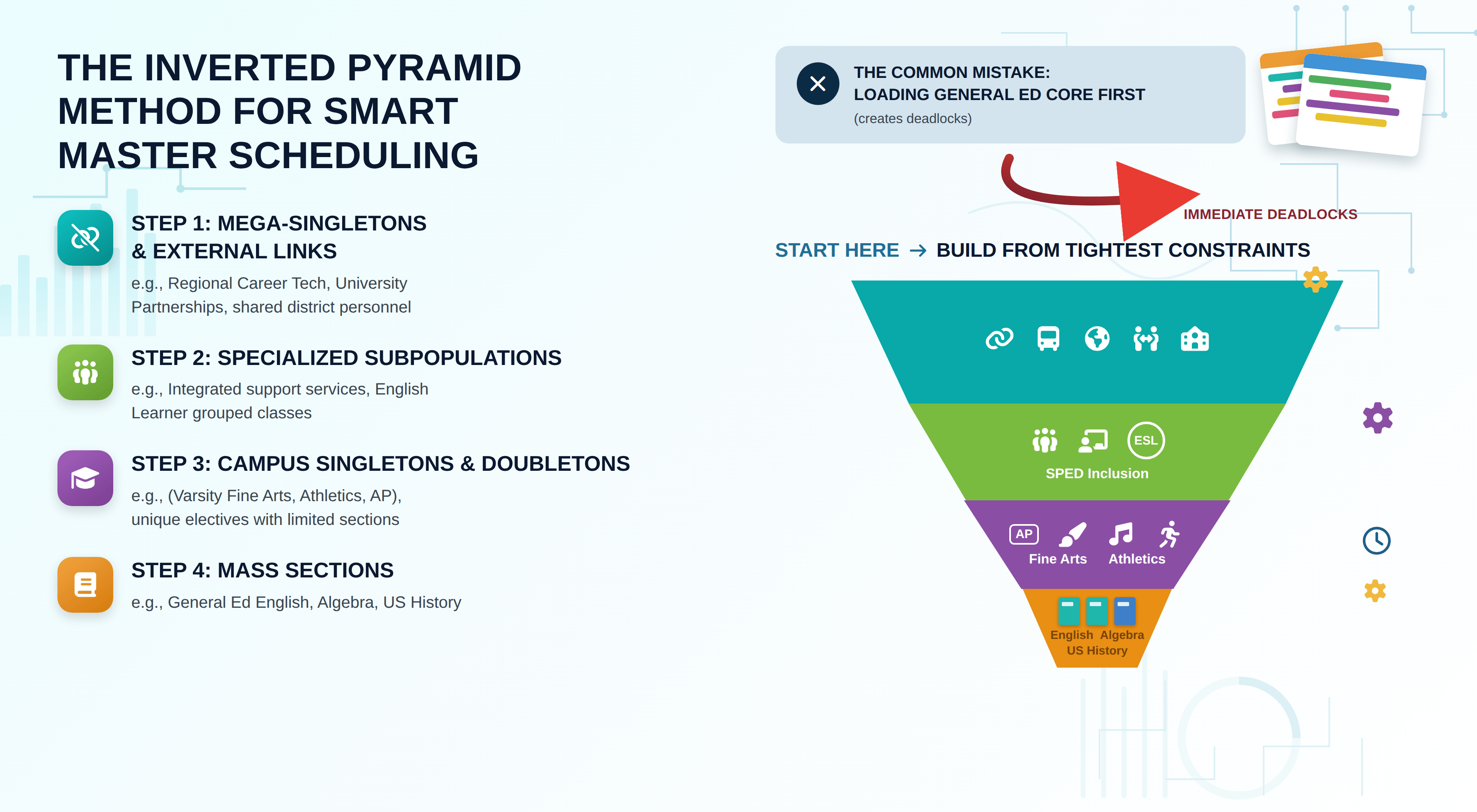
The most common scheduling mistake is loading general education core classes first because they have the most sections. This creates immediate deadlocks later. Instead, use the Inverted Pyramid Method to build from your tightest constraints outward.
- Step 1: Mega-Singletons & External Links (Dual Credit, Shared Staff)
- Step 2: Specialized Subpopulations (SPED Inclusion, ESL Clusters)
- Step 3: Campus Singletons & Doubletons (Varsity Fine Arts, Athletics, AP)
- Step 4: Mass Sections (General Ed English, Algebra, US History)
Download our FREE Strategic Master Scheduling Checklist for a comprehensive timeline, key planning steps, and compliance considerations to support your scheduling process.
Step 1: Mega-Singletons & External Factors
Lock in the elements you do not control first. This includes traveling teachers shared with other district campuses, specialized off-site CTE labs, and Dual Credit courses tied directly to the availability of local community college professors.
Step 2: Specialized Student Subpopulations
Flip the script on your special education and emergent bilingual populations. Treat your co-teaching pairs as absolute singletons. If a general education teacher and a special education inclusion teacher are paired for Algebra I, lock that specific team into their instructional periods immediately. Next, ensure their common planning time is locked into the same period. Building around your most vulnerable student populations first eliminates the mid-August crisis of realizing a student’s IEP accommodations are logistically impossible to fulfill.
Step 3: Campus Singletons & Doubletons
Place the courses that only happen once or twice a day. This includes varsity athletics, major fine arts ensembles (like Band or Choir), and specialized Advanced Placement (AP) courses. Cross-reference your student request data to ensure your lone AP Chemistry section does not run at the exact same time as Varsity Football or Headliner Theater.
Step 4: Mass Sections
Fill in your general education core sections (like English II or World Geography) last. Because you have multiple sections of these courses spread across the day, your scheduling software has the maximum flexibility to route students around the fixed singletons established in steps 1 through 3.
Pitfalls to Avoid This Year
- The “Copy-Paste” Temptation: It is tempting to reuse last year’s master schedule and simply swap teacher names. However, doing so ignores critical shifts in student data, changes in incoming feeder-pattern sizes, and new IEP requirements. Every school year requires a fresh build driven by current data.
- Isolating Novice Teachers: Avoid the trap of giving your newest, uncertified, or first-year teachers multiple different class preparations or the highest concentrations of struggling students. Balance the course load across your department veterans to protect your staff from burnout and accelerate teacher retention.
- Siloed Planning: Avoid building the schedule in a vacuum. Collaborate directly with your counseling team, athletic directors, and fine arts chairs early in the spring. Finding out about a major scheduling conflict in August costs you valuable instructional days.
Your Strategic Master Scheduling Checklist
🟩 January: Data Collection & Forecasting
- Review CCMR & CTE Pathways: Audit TEA regional programs of study to ensure upcoming course offerings maximize accountability points.
- Publish Course Guide: Update the campus course catalog with accurate descriptions and graduation requirements.
- Launch Student Choice Sheets: Distribute course selection materials to current and feeder-pattern students.
- Track Certification Changes: Audit current staff teaching certifications using the Texas SBEC portal to identify future gaps or upcoming expirations.
🟨 February: Request for Validation & Staffing Projections
- Tally Student Requests: Clean student choice sheet data and aggregate total requests per course.
- Determine Section Counts: Divide total course requests by target class size caps to calculate required sections.
- Conduct Staffing Intent Surveys: Gather formal data on staff retirements, resignations, or internal transfer requests.
- Submit Staffing Allocations: Present data-driven personnel requests to the central office based on enrollment projections.
🟪 March: Structural Design & Framework Selection
- Finalize District Allotments: Secure approved campus FTE counts and staffing budgets from the district office.
- Analyze Student IEP/504/ELL Needs: Collaborate with Special Education and ESL coordinators to project required inclusion, co-teaching, and resource sections.
- Define the Structural Grid: Lock in the campus day framework (e.g., traditional 7-period, 8-period, or A/B Block) and determine lunch wave placements.
- Draft the Master Schedule Grid: Create the digital matrix within your student information system (SIS), such as Skyward, Ascender, or PowerSchool.
🟦 April: The “Inverted Pyramid” Build Phase
- Lock In Shared Staff and Dual Credit: Coordinate with regional community college partners and district campuses to pin down traveling teacher schedules.
- Schedule SPED and ESL Co-Teaching Blocks: Place high-needs inclusion pairings onto the grid first to guarantee common planning times.
- Anchor Campus Singletons: Place specialized courses that run only once a day (e.g., Varsity Band, Athletics, AP Sciences).
- Seat the Doubletons and Tripletons: Distribute courses with two or three sections across the day to prevent scheduling deadlocks.
🟧 May: Mass Loading & Conflict Resolution
- Load Mass Sections: Input general education core classes to fill out the remainder of the grid.
- Run Initial Student Simulation Loads: Execute the automated student placement algorithm within your SIS to analyze the match rate.
- Resolve Scheduling Bottlenecks: Manually adjust conflicting singleton sections to drive the initial student match rate above 85%.
- Review State Compliance Mandates: Verify every full-time teacher has a minimum of 450 planning minutes every two weeks, with a daily 45-minute consecutive block.
🟥 June & July: System Maintenance & Section Balancing
- Audit Final STAAR / EOC Scores: Review late-spring state testing data to identify students requiring mandatory accelerated instruction.
- Insert Intervention Blocks: Build targeted remediation or advisory sections for students requiring academic support.
- Process New Enrollments and Withdrawals: Update student rosters weekly as families move in or out of the attendance zone.
- Balance Class Sizes: Shift student schedules to equalize section numbers across core academic subjects.
⬛ August: Final Verification & Rollout
- Verify Room Assignments: Cross-reference class sizes with physical room capacities and specialized equipment needs.
- Distribute Preliminary Teacher Schedules: Hand out schedules during professional development week to allow for emergency correction requests.
- Review IEP Accommodation Matches: Run a final compliance check ensuring special education students are correctly placed in classrooms matching their legally mandated accommodations.
- Go Live and Release Student Schedules: Open the student portal for schedules, celebrating a conflict-free start to the school year.
Final Thoughts: Stewardship of Time
Master scheduling is ultimately an act of campus stewardship. By intentionally planning ahead and building your schedule around compliance rules, equity, and strategic constraints, you prevent the mid-August scramble. A clean, conflict-free master schedule protects teacher morale, reduces student frustration, and sets a predictable, orderly tone for your entire school year.

Andrea is a Leadership Certification Specialist here at ESC Region 13.



Add comment