

When preparing to deliver an upcoming unit of study or lesson, do you plan for teaching or plan for learning? Or, asked another way, when you look at your planning document, who do you see—your students or yourself? While teaching and learning may seem like two sides of the same coin, when it comes to lesson planning, your intent and focus matter. This article explores planning for teaching vs planning for learning.
Planning for Teaching
Planning for teaching is the traditional lesson/unit planning model that is written from the teacher’s perspective, detailing what steps they need to take to lead instruction in the classroom. While this approach helps teachers organize their delivery, it too often leads teachers to dive straight into the lesson by introducing new facts, concepts, and other knowledge without first getting their students curious and motivated to learn.
Planning for Learning
Planning for learning focuses on mapping out what students will need to experience and think about during the course of the unit or lesson in order to create meaningful, lasting knowledge and skills. This brain-based approach includes a clear description of what successful learning looks like and explicitly plans to support students’ curiosity, commitment, and effort. These elements greatly improve academic outcomes and help students be more engaged and persistent with learning.
Planning for Learning is Founded in Cognitive Science
Planning for learning draws a lot from cognitive science on how the brain processes information and creates memory and understanding.
From these insights and McREL’s analysis of dozens of high-quaility studies in real classrooms, we’ve found that learning is most effective when students experience these six phases of learning:
- Become interested
- Commit to learning
- Focus on new learning
- Make sense of learning
- Practice and reflect
- Extend and apply
When using a planning for learning approach, teachers intentionally address each of these phases in their lesson/unit plans to ensure all their students are primed and supported for academic success.
Comparison of Planning for Teaching vs Learning
| Planning for Teaching | Planning for Learning |
|---|---|
| Tell students the topic of today’s lesson. | Hook student interest and curiosity in the lesson and connect it to their experiences (help them to become interested). |
| Share my teaching objective. | Involve students in setting personal goals for learning (help them commit to learning). |
| Teach the material. | Help students verbalize and visualize new learning by modeling processes and illustrating key concepts with diagrams, graphics, and examples (help them to focus on new learning). |
| Have students memorize vocabulary terms. | Help students develop conceptual understanding of new vocabulary and by using new words in writing and classroom discourse (help them to focus on new learning). |
| Ask questions to see if students are learning and paying attention. | Ask high-level questions. Prompt students to think about learning and make their thinking visible, thereby helping them to consolidate new learning (help them make sense of learning). |
| Give students some time to practice in class. | Observe students as they engage in their initial application of new learning and provide immediate, formative feedback (help them make sense of learning). |
| Occasionally engage students in small group work. | Regularly give students time to pause and process their learning, making connections to prior learning, categorizing, and thinking about learning. Structure activities to support individual and/or peer-assisted consolidation of learning (help them make sense of learning). |
| Assign homework. | Help students move new learning to long-term memory by using multiple practice sessions over time. Prompt them to practice new learning while rehearsing prior knowledge (help them to practice and reflect). |
| Give pop quizzes to keep students on their toes. | Help students build long-term memory by using retrieval practice – ungraded quizzes that prompt students to recall new learning (help them pactice and reflect). |
| Give a test and move on to the next unit. | Help students embed new learning into long-term memory by using new knowledge and skills for research, experiments, investigations, extended writing tasks, or solving complex problems (help them extend and apply). |
What Planning for Learning Looks Like in the Classroom
So, what does planning for learning look like in action? Say, for example, a state math standard requires seventh graders to solve real-life problems involving measurement of angles, surface area, and volume. Following the planning for learning approach, we first need to define what student success looks like: Students will learn how to calculate a variety of geometric measurements.
Next, the teacher asks themselves, “How can my students do this and why should they want to?” The teacher then creates a learning objective to engage students and make it applicable to real life.
Starting the Unit of Study When Planning for Learning
To start the unit of study, the teacher talks with students about their favorite things to do at a park. Then the teacher presents students with pictures and a map of a local park and explains that they will need to redesign it, incorporating several of their favorite park elements, including:
- a walking path
- raised garden beds
- a pond
- a playground
- a seating area
They will also need to use the math knowledge that you’ll be presenting over the course of the unit.
At this stage, the teacher has captured the students’ interest and curiosity, set a clear goal that extends beyond just achieving a letter grade, and linked it to real-life experiences outside the classroom.
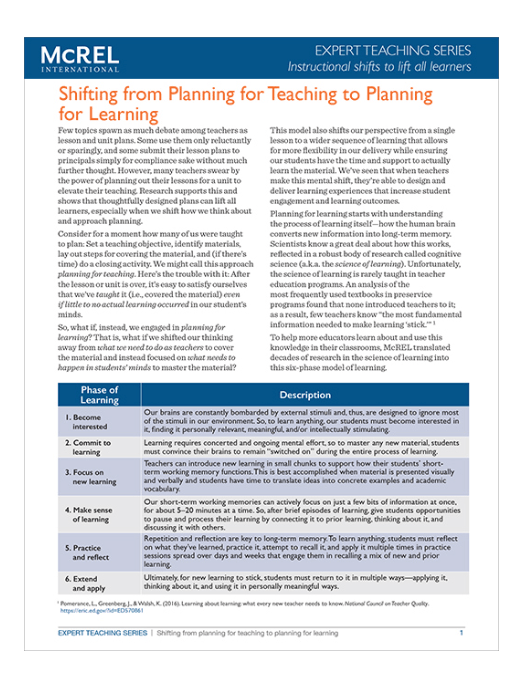
Expert Teaching Shifts: Planning for Learning
This free four-page document gives an overview of planning for student learning and provides a few suggested next steps for school leaders and teachers interested in navigating this shift in practice.
Lesson Sequence When Planning for Learning
The lessons are then sequenced and designed in a way to support how their brains receive new information, make sense of it, combine it with things they already know, and store it away as long term, usable knowledge.
Lessons cover math vocabulary instruction, provide visualizations and concrete examples, and directly demonstrate math functions and processes. The class tours the school grounds, looking at planter boxes, pathways, sports fields, and parking lots, and discusses the math formulas used to create each of the elements.
Back in the classroom, students get to work. They process their new information, map out their park design, and calculate square footage of various sections and the volume of soil and water needed to fill garden beds and ponds. They work independently and, from time to time, in small groups to process their new learning.
Providing Formative Feedback
Throughout their work, the teacher provides formative feedback, encouraging students to revisit and reflect on their initial and evolving designs. They are supported to adjust and improve their park designs so their measurements are accurate and placements are to scale. This reflection and repetition aid in processing, retrieval, and retention.
As students finalize their design projects, they create presentations that explain their design, using text and images.
By developing a clear, student-centered goal for the learning and intentionally sequencing and balancing learning, reflection, and application, the teacher has transformed what might have been a rather pedestrian sequence of lessons about geometry into something real and relevant for students.
Resources
Go deeper into the phases of student learning with these professional resources from The McREL Institute at ESC Region 13.
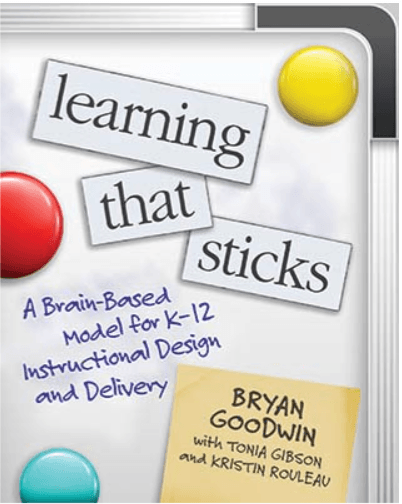
Learning That Sticks
Learning That Sticks describes a model for planning and delivering instruction that’s based on cognitive science. The six-phase model for student learning shows teachers how to capture students’ interest in learning. It also gives suggestions for sustaining motivation and commitment to learning, and creating deep, long-lasting knowledge.
- Learn more about the book.
- Learn more about the online course.
Using Brain Science to Make Learning Stick
Using Brain Science to Make Learning Stick provides classroom activities to help students turn new information into memory. Based on scientific research, it offers K–12 teachers ways to make the process of learning more effective, engaging, and rewarding.
- Learn more about the book.
Unleashing the Power of Best First Instruction
Unleashing the Power of Best First Instruction is a white paper explaining the power of best first instruction and describes each of the 14 strategies in The New Classroom Instruction That Works.
- Get your copy of the paper.
For the most current professional development, self-paced online courses, and resources, visit our website.
Additional Resources
Find out more about the McREL Institute at ESC Region 13 on our website. Go to the ESC Region 13 blog for additional articles on Strategic Instruction.
Note: This article was originally published on the McREL Institute blog on December 6, 2022. It was revised for the ESC Region 13 blog in August 2026.

Bryan Goodwin is the Deputy Executive Director for the McREL Institute at ESC Region 13.



Add comment