

At various professional learning events over the last couple of years, I’ve shared that there’s scant scientific evidence that posting learning objectives improves student learning. It sometimes ruffles some feathers with educators remarking, “What?! How can that be when so many teachers are required to post learning objectives in their classrooms?”
But here’s the reality: learning objectives are necessary but not sufficient to improve student outcomes. Student goal setting is a key strategy for success in the classroom.
Teachers Must Be Clear With Objectives
Without a doubt, teachers must be clear in what they want students to learn. However, until students translate learning objectives into their own learning goals, the objectives posted in the front of the room are a bit like a proverbial tree falling in the woods with no one around to hear it.
Getting Students To Own Their Goals
As it turns out, student goals are incredibly powerful. In The New Classroom Instruction that Works, we analyzed 14 scientific studies conducted across a variety of classrooms that found powerful effects for students who set their own learning goals.
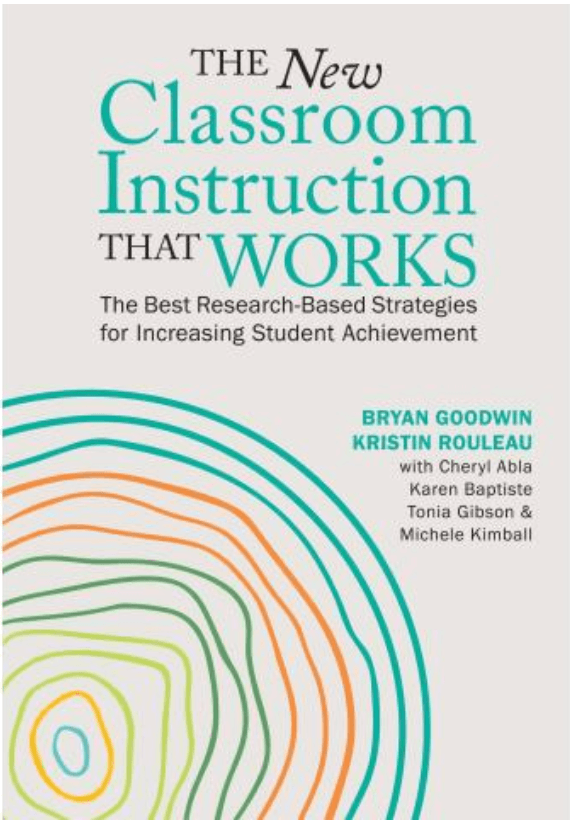
In The New Classroom Instruction That Works: The Best Research-Based Strategies for Increasing Student Achievement, by Bryan Goodwin, Kristin Rouleau, and Tonia Gibson, you’ll learn about 14 research-based instructional strategies that teachers of all grade levels can use to deliver the best first instruction that increases student learning outcomes.
Available through the McREL Institute at ESC Region 13, The New Classroom Instruction That Works also includes a free study guide.
Getting kids to take ownership of their learning is easier said than done, of course. An important first step in the process is helping students to become interested in their learning.
A tool to help do this is a student interest inventory. Teachers can use this tool to cultivate students’ curiosity and engagement.
Once students are interested in learning, a new challenge emerges: helping students commit to learning. As it turns out, decades of research on student motivation show that before students commit to learning, they need to see what they’re being asked to learn is achievable and meaningful.
What’s In It For Me?
Teachers can help students find meaning in their learning by providing students with a What’s In It For Me? (WIIFM) statement. For example, what’s in it for students if they commit to learning science concepts, math formulas, or writing skills? How might they use this information or these skills in the real world? Their own lives? Or to build toward later learning?
One way to give students a WIIFM is to add two words—”so that”—to our learning objectives and complete the sentence, “We will learn X, so that we can Y.”
What’s In It For Me?
We will learn X, so that we can Y.
For example: “We will learn how to calculate the area of a variety of four-sided polygons so that we can calculate the dimensions and size of sports fields, homes, offices, and other actual spaces in our world.”
The Why Behind the Ask
Without a doubt, figuring out why we’re asking students to learn something is no small task. Yet if we don’t figure out why we’re asking students to learn something, we can be sure they’ll struggle to figure it out, too.
If we take the time to help students set meaningful learning goals, they are more likely to take ownership of their learning and feel a sense of true accomplishment when they achieve them.
And that points to a WIIFM for teachers to apply these best-first instruction strategies in their classrooms. Then it makes learning easier and more joyful for their students and themselves.
Resources
Find out more about the McREL Institute at ESC Region 13 by visiting our website. Here you can learn about upcoming professional development opportunities and resources. Visit the ESC Region 13 blog for more articles related to Strategic Instruction.
Below are additional resources about student goal setting:
- Free whitepaper: Unleashing the Power of Best First Instruction
- Blog article: Going Slow To Go Fast, With Best First Instruction
- Podcast: What’s New with The New Classroom Instruction That Works?
Note: This article was originally published on the McREL Institute blog on September 28, 2023. It was revised for the ESC Region 13 blog in April 2026.

Bryan Goodwin is the Deputy Executive Director for the McREL Institute at ESC Region 13.



Add comment