

They say, “It takes a village.” In special education, this village consists of professionals with various roles, experiences, and areas of expertise, collaborating to offer meaningful support and services for students with disabilities. Teacher–Paraeducator collaboration is critical in special education.
For those who have spent time in schools, it’s no surprise that teams of teachers and paraeducators can sometimes function with the precision of a well-designed system, each person contributing a crucial piece to student sucess. At other times, however, teams may feel disjointed, struggling with uneven expectations, miscommunication, and role confusion that create gaps in student support.
During these moments, intentional collaboration and clearly defined expectations help teams stay aligned and responsive to student needs.
Understanding Roles Within the Special Education Team
Within the special education team, both teachers (general and special education) and paraeducators contribute in meaningful and distinct ways to a student’s instructional journey.
Teachers are responsible for instructional planning, decision-making, and Individualized Education Program (IEP) development.
Day-to-Day Team Work
In practice, this includes determining the scope and sequence of instruction needed for student mastery. General education teachers bring expertise in grade-level standards, while special education teachers specialize in designing access points to those standards for students with disabilities. Together, they ensure access to rigorous, meaningful content.
Teachers also design classroom management systems that promote independence and support positive behavior. These systems, routines, expectations, and instructional structures create the conditions necessary for learning.
A critical component of the teacher’s role is IEP development. Using data-driven insights, teachers collaborate with IEP team members to create individualized plans that reflect each student’s strengths, needs, and goals.
Within these systems, paraeducators serve as the bridge between planning and implementation.
How Paraeducators Support an IEP
Often descirbed as ensuring quality and consistency, paraeducators support the fidelity of IEP implmentation. While their role may be less visible, it is equally essential. Paraeducators follow instructional guidance to ensure that plans are carried out accurately and consistently.
Under the supervision of a certified teacher, paraeducators bring the IEP to life by collecting data and providing feedback on student progress. This ensures the IEP remains a dynamic, responsive tool.
Perhaps most importantly, paraeducators build strong relationships with students, often serving as advocates who support access, engagement, and belonging across learning environments.
When roles are clearly defined, both teachers and paraeducators can work with confidence, strengthening team effectiveness and improving student outcomes.
Why Strong Collaboration Matters in Special Education
When each team member understands their role, supports for students with disabilities are implemented consistently across settings.
This consistency depends on ongoing collaboration throughout IEP implementation.
Fidelity is strongest when teachers and paraeducators regularly reflect on how supports are working in practice. Collaborative conversations may include questions such as:
- Do accommodations support access consistently across classrooms?
- How does the student demonstrate understanding across tasks?
- Can the student generalize skills across settings and staff?
These insights are essential. When collaboration is embedded into daily practice, IEPs become more responsive, individualized, and aligned with students’ real experiences.
A culture of collaboration keeps the focus on students. Even during busy and demanding times, a shared commitment to student success reinforces that every role matters.
What Effective Teacher–Paraeducator Collaboration Looks Like
Strong collaboration depends on understanding, and respecting, each role. Collaboration is not an added task. It is an essential part of effective practice.
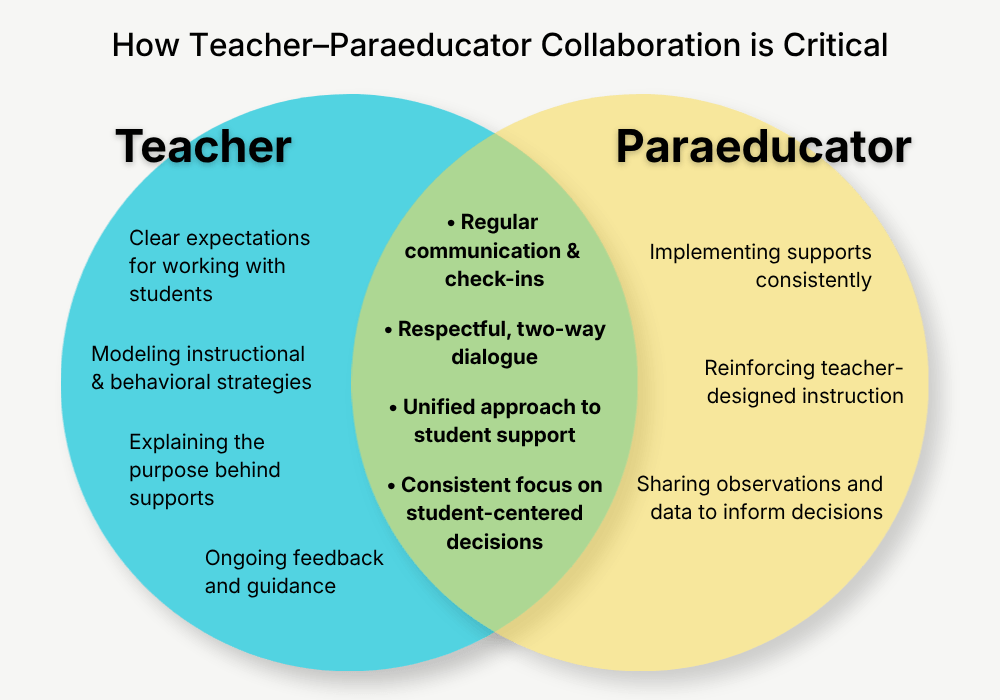
Teachers support collaboration by providing:
- Clear expectations for working with students
- Modeling instructional and behavioral strategies
- Explaining the Purpose behind supports
- Ongoing feedback and guidance
Paraeducators strengthen collaboration by:
- Implementing supports consistently
- Reinforcing teacher-designed instruction
- Sharing observations and data to inform decisions
Effective teams also maintain:
- Regular communication and check-ins
- Respectful, two-way dialogue
- A unified approach to student support
- Consistent focus on student-centered decisions
Strong Teams Create Strong Outcomes
Strong special education teams are built through intentional effort. Teacher–paraeducator collaboration is critical to team success. Clear roles, open communication, and shared responsibility create the conditions for success.
When teachers and paraeducators work together effectively, students with disabilities receive consistent, meaningful support designed to help them succeed.
In special education, collaboration is more than working together. It ensures every student is supported by a team that is aligned, prepared, and purposeful.
Resources
Find out more about ESC Region 13 Special Education by visiting our website. Here you can select a focus area and view upcoming professional development, resources, or subscribe to the Special Education newsletter. Visit the ESC Region 13 blog for more related articles to special education and classroom strategies.

Emily Johnson serves as the Low Incidence Disabilities Specialist at ESC Region 13.


Add comment