

One of the most effective ways to ensure the success of all students is to concentrate on providing high-quality Tier 1 foundational instruction in every classroom, every day, for every student. The McREL Institute, along with others, refers to this as “best first instruction.” Through our research for The New Classroom Instruction That Works, we identified 14 teaching strategies that support best first instruction. This article explains those 14 teaching strategies for best first instruction in every classroom.
What is Best First Instruction?
Best first instruction is defined as “the skillful use of proven teaching techniques that are intentionally sequenced to help all students convert new learning into long-term memory.” This concept is explained in our white paper, Unleashing the Power of Best First Instruction.
The 14 Strategies from Classroom Instruction That Works
The 14 teaching strategies identified have a significant effect on learning outcomes for a diverse range of students. Each of these strategies is supported by at least seven peer-reviewed studies that meet the rigorous review criteria set by the national What Works Clearinghouse.
Let’s dive into these strategies for best first instruction that teachers of any grade level or content area can adapt and use to engage their students in learning and improve student achievement.
They are grouped into three big categories of building knowledge and memory.
Three Categories of Building Knowledge and Memory
- Activate – Gain students’ interest, motivation, and commitment to learning.
- Build – Help students understand and make sense of what they’re learning.
- Deepen – Help students create lasting knowledge they can use in a variety of contexts.
These categories, and their associated strategies, are not a strictly linear process. During a lesson, you might need to go back to an earlier topic or method a few times. This can help students refocus, reset, or recharge.
Activate Strategies
Strategies in the Activate group gain students’ interest, motivation, and commitment to learning.
- Cognitive Interest Cues Strategy: When teachers can introduce a unit of study or a lesson in a way that sparks students’ curiosity and has some relevance and meaning to their lives, it naturally grabs their attention. It also drives their interest in learning. Effective cues relate directly to the desired learning outcomes, help students make a personal connection to the material, and engage students in thinking about what they will learn.
- Student Goal Setting and Monitoring Strategy: Once you have your students’ attention and interest, it’s time to present the unit or lesson’s main learning objectives. Instead of merely posting objectives on a whiteboard, it is much more effective to assist students in transforming them into personal learning goals. When students are engaged in their own goal setting and monitoring, it’s easier for them to remain committed to learning. Student goals should focus on mastering concepts, processes, and skills (what they will learn and be able to do), rather than what grade they will earn.
Build Strategies
Build strategies help students understand and make sense of what they’re learning.
- Vocabulary Instruction Strategy: Words are the pegs on which we hang ideas. Many studies indicate students learn better when teachers directly explain the meanings of words or terms they will see in the lesson. This is better than students trying to figure out meanings from context. It’s worth noting that quality trumps quantity — learning fewer new words deeply beats learning many new words superficially.
- Strategy Instruction and Modeling Strategy: Students learn faster when they see new skills, processes, and thinking strategies demonstrated for them. In other words, show and tell your students what they need to learn through direct modeling and step-by-step demonstrations.
- Visualization and Concrete Examples Strategy: It seems everyone’s a visual learner, at least in part. Students benefit greatly when teachers show and use diagrams, graphic organizers, illustrations, animations, manipulatives, worked-out examples, videos, and simulations when explaining new ideas and abstract concepts.

Read the complete “Unleashing the Power of Best First Instruction” White Paper from the McREL Institute at ESC Region 13 by downloading your own copy.
Visit the McREL website for more information.
- High-level Questions and Student Explanations Strategy: High-level questions go beyond simple recall of facts. They prompt students to process what they’re learning and explain their thinking, either individually or with others. It’s helpful to directly show students how to self-reflect on their learning: to think about what questions they have, what connections they can make to other things they’ve learned, what “next steps” might be, and how to check their processes and progress.
- Guided Initial Application with Feedback Strategy: After watching a new skill demonstrated, students should practice it with help, direction, and feedback. Teacher feedback should be direct (but supportive) correcting any errors or misconceptions. Once students have a solid understanding of the basic concepts and processes, shift feedback to encourage them to be self-reflective and self-corrective. As students master reflecting on their work, focus feedback on helping them gauge their progress and increasing their efficiency and “automation” with complex problem-solving processes.
- Peer-Assisted Consolidation of Learning Strategy: The mental process of linking new information and ideas with existing knowledge to understand them better is consolidation. Research shows when students can discuss, practice, and think through new learning in small groups with their peers, it greatly helps consolidation and memory.
Deepen Strategies
Strategies related to Deepen help students create lasting knowledge they can use in a variety of contexts.
- Retrieval Practices (Quiz to Remember) Strategy: Research shows that quizzing ourselves is one of the best ways to remember new information for a long time. The very act of racking our brains to find the answer strengthens our memory of that new learning. So, while quizzing is often used to measure learning, it’s really a great teaching strategy.
- Spaced, Mixed Independent Practice Strategy: After we learn something, it can start to fade if we don’t use it. Studies show that the best way to remember information for a long time is to go back to it and practice it many times, spreading the practice over days and weeks. And those practice sessions shouldn’t all be the same. Research suggests mixing up the type of practice we do further strengthens our memory and understanding. Students should take part in at least three practice sessions. These sessions should help them remember both new and old lessons and be spaced out over a few days.
- Targeted Support (Scaffolded Practice) Strategy: Despite our best efforts as teachers, not all students will master new concepts the first time they encounter them. So, it’s important to check student progress regularly. Doing so helps identify students who could benefit from re-learning and re-practicing knowledge and skills. Along with slightly different instruction and support that’s tuned to their individual strengths and needs.
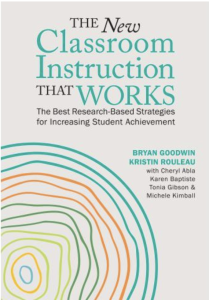
Get your copy of The New Classroom Instruction That Works on the McREL Institute at ESC Region 13 website.
Be sure to download the free study guide too!
Visit the McREL website for more information.
- Cognitive Writing Strategy: Extended writing assignments are one of the best ways for students to deepen their understanding and memory. It’s important because it requires them to synthesize, analyze, evaluate, and express their own ideas about what they’re learning. It’s important for teachers to provide students with direct instruction in thinking and writing strategies. This includes using graphic organizers and other guides to arrange their thoughts as they put them on paper.
- Guided Investigations Strategy: Research indicates that allowing students to engage in deep thinking about learning facilitates the encoding of that learning into long-term memory. We can do this by giving them chances to try experiments, explore topics on their own, and work on research projects. These will mix student-led learning with guidance from teachers.
- Structured Problem Solving Strategy: Like guided investigations, when students use what they’ve learned to solve real-world problems, it helps them to embed learning deep into long-term memory. When engaging students in solving a complex problem, it’s important to offer students step-by-step guidance for dissecting the problem. Doing so helps students develop the know-how to solve similar problems later.
Using the Strategies Like an Expert
Knowing what these strategies are is only half of the equation for delivering best first instruction. Understanding how and when to use them is the second part. Expert teachers understand how each of these strategies supports the learning process and plan for specific moments in a unit or lesson to implement them.
In this article, we’ve briefly touched on when to use each strategy with our Activate, Build, and Deepen categories. To learn more about how and when to utilize them, we recommend exploring these resources:
- A crosswalk of the learning model and the Classroom Instruction That Works strategies (Free download)
- Learning That Sticks
- Classroom Instruction That Works
- Research-Based Instructional Strategies That Work (Quick Reference Guide)
- Using Brain Science to Make Learning Stick (Quick Reference Guide)
Additional Resources
Find out more about the McREL Institute at ESC Region 13 by visiting our website. Here you can learn about upcoming professional development opportunities and resources. Visit the ESC Region 13 blog for more articles on Strategic Instruction. You can also read our post on Student Goal Setting, which provides information related to the book The New Classroom Instruction That Works.
Note: This article was originally published on the McREL Institute blog on August 1, 2023. It was revised for the ESC Region 13 blog in May 2026.

Bryan Goodwin is the Deputy Executive Director for the McREL Institute at ESC Region 13.



As a fourth-grade teacher, I already use several of these strategies, including learning targets, collaborative learning, questioning, and providing feedback during guided instruction. This article reminded me that strong Tier 1 instruction should always be the first step in supporting student success. By intentionally using these evidence-based strategies every day, I can better meet the diverse needs of my students while reducing the need for additional interventions.