

The Texas Education Agency’s (TEA) Texas Mathematics Academies (TMA) represent a major statewide initiative to strengthen mathematics instruction and improve student outcomes. Pilot implementation of the program for kindergarten through grade 3 will begin in the 2026-2027 school year. Let’s explore what you need to know about the new Texas Mathematics Academies.

The Big Picture
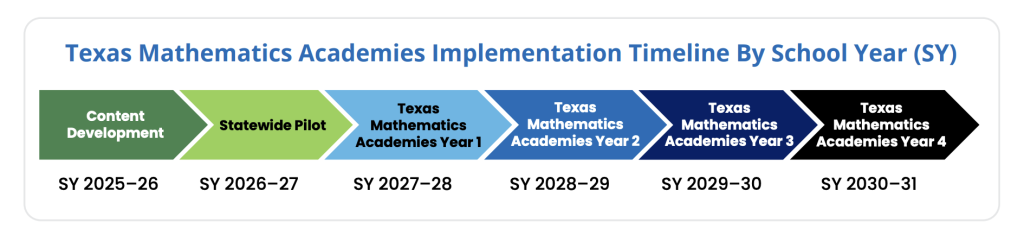
- Legislative Requirement: Participation in the Texas Mathematics Academies is mandated by Texas Education Code (TEC) §28.0071 House Bill (HB) 2, and requires completion of the Texas Mathematics Academies for K-3 staff by the end of the 2030–31 school year.
- A Solid Mathematics Foundation: The academies aim to build expertise in delivering effective, systematic mathematics instruction through research-based strategies. Grounded in the science of learning, the Texas Mathematics Academies are designed to strengthen pedagogical knowledge throughout the required modules. The academies focus on grade-level specific foundational skills in fluency, problem-solving, place value, early fraction concepts, and whole number operations.
Funding & Costs
- Registration Fee: School districts are required to pay $1,200 per participant, funded through the Early Childhood Allotment.
- Stipends: Districts must pay a $50 per hour stipend if they require attendance outside of normal contracted service days, regardless of the grade level participants teach.
- Stipend Exceptions: A school system is not required to provide a stipend to a classroom teacher under the following circumstances:
- If a teacher fails their first attempt.
- If the teacher attends the mathematics academy on a day or during hours of service included in the term of the teacher’s contract.
- If a teacher is not directed or approved by the school district at which the teacher is employed to attend the mathematics academy (e.g., the teacher participated in the academies on their own).
- If the teacher attends the mathematics academy as part of an educator preparation program in which the teacher is enrolled.
Who is Required to Attend?
- Mandatory Roles: Classroom teachers who provide instruction in mathematics to students in grades K–3, along with principals, assistant principals, mathematics instructional coaches, and mathematics interventionists at campuses serving these grades.
- Optional Participation: Professional development for grades 4 and 5 (the “Deep Dives”) remains optional but highly encouraged.
The Academy Experience: Structure & Pathways
- Time Commitment: A total of 30 hours of coursework designed to be completed over an 11-month period.
- Blended Learning: The program uses a mix of face-to-face, synchronous, and asynchronous experiences.
- Customized Pathways: Local school systems will determine the pathway that best fits an educator’s role:
- Administrator
- Kindergarten/Grade 1
- Grade 2
- Grade 3
Module Breakdown: What You’ll Learn
Below is general information and a breakdown of modules.
- The five modules are delivered across the school year, providing a structured and comprehensive professional learning experience.
- Participants will complete three artifacts that serve as evidence of mastery, requiring participants to apply, demonstrate, and document instructional practices.
- Participants are required to meet one to one with their Cohort Leader virtually twice throughout the modules.
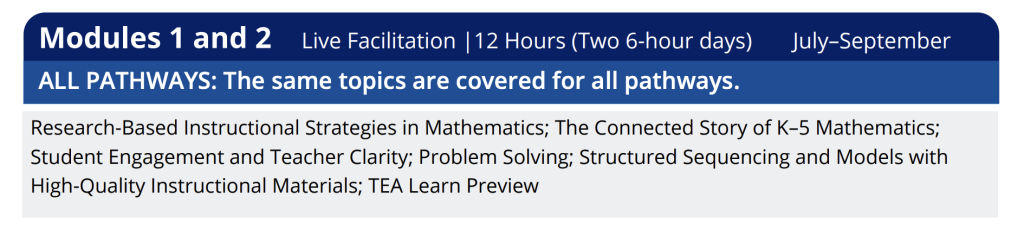
- Modules 1 & 2 (Live Facilitation): Focus on the “connected story” of K–5 math, student engagement, and high-quality instructional materials.
- Participants register for their pathway-specific TEA Learn Canvas course and receive their course materials.
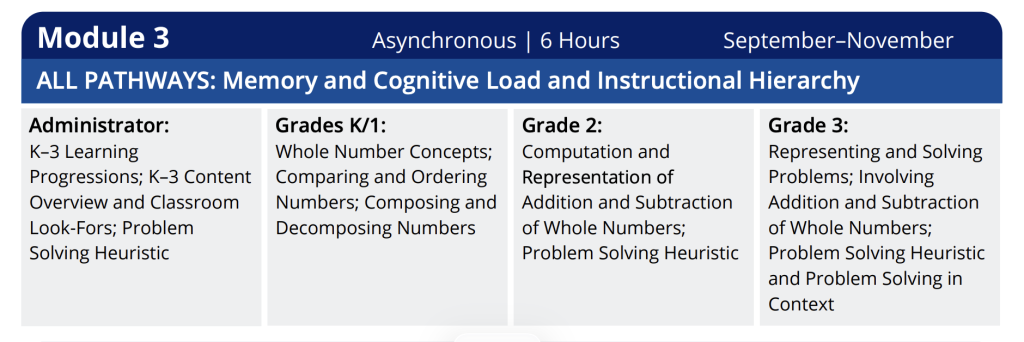
- Module 3 (Asynchronous): Covers the Science of Learning, including memory, cognitive load, and the instructional hierarchy.
- Participants will submit an artifact.
- Module 3 (Synchronous): Covers the Science of Learning, including memory, cognitive load, the instructional hierarchy and includes pathway-specific math content.
- Participants will meet one to one virtually with their Cohort Leader one time.
- Optional office hours will be held by the Cohort Leader.
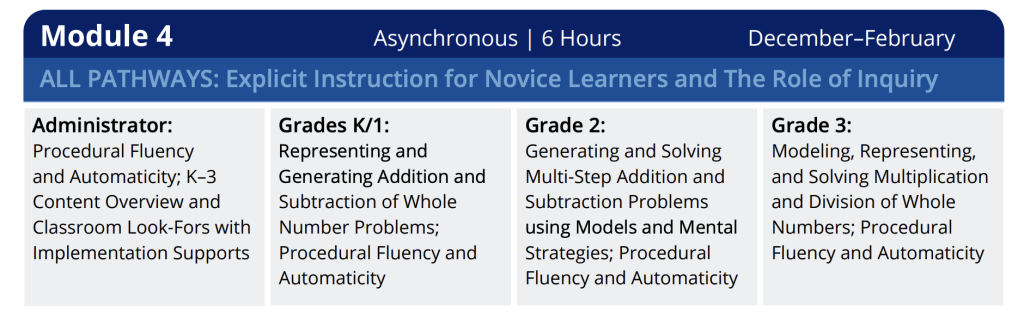
- Module 4 (Asynchronous): Dives into explicit instruction for novice learners and the role of inquiry.
- Participants will submit an artifact.
- Optional office hours will be held by the Cohort Leader.
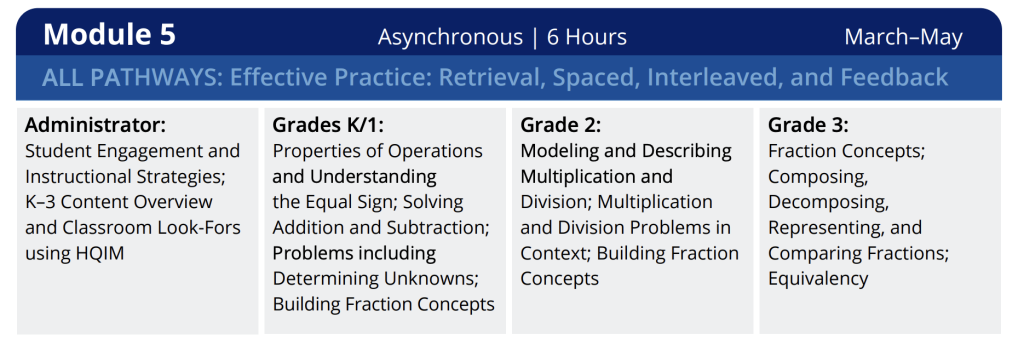
- Module 5 (Asynchronous): Focuses on effective practice techniques like retrieval, spaced, and interleaved practice.
- Participants will submit an artifact.
- Module 5 (Synchronous): Focuses on effective practice techniques like retrieval, spaced, and interleaved practice, and includes pathway-specific math content.
- Participants will meet one to one virtually with their Cohort Leader one time.
- Optional office hours will be held by the Cohort Leader.
Beyond K–3: The Grade 4 & 5 “Deep Dives”
- Overview: Formerly known as Mathematics Achievement Academies, these are 18-hour, face-to-face sessions held over three days.
- Grade 4 Focus: Addition/subtraction of whole and rational numbers, multiplication/division of whole numbers and fraction concepts.
- Grade 5 Focus: Addition/subtraction of whole and rational numbers, multiplication/division of whole and rational numbers, and fraction operations.
- Stipends are to be provided by districts to educators who attend outside of contract hours.
Implementation Timeline & Next Steps
- SY 2026–2027: The K–3 TMA Statewide Pilot year; interested districts should contact their regional Education Service Center (ESC).
- SY 2027–2028: Authorized provider applications open for districts.
Next Steps
- Check out the Texas Mathematics Academies FAQ Document to review frequently asked questions.
- Connect with your district leadership or regional Education Service Center (ESC) to understand your timeline, pathway, and expectations for participation. If you are in Region 13, please connect with the Authorized Provider, Alejandra Gonzalez (alejandra.gonzalez@esc13.txed.net)
ESC Region 13 is here to help! Connect with Alejandra Gonzalez with additional questions about Texas Mathematics Academies. Subscribe to our newsletter for the latest updates and resources in Mathematics and other subject areas. Visit our website for professional development opportunities, math-related services, resources, and products. For more articles related to mathematics, visit the ESC Region 13 blog.
NOTE: This article was updated on June 19, 2026. Please continue to check this article for future updates and new information as this program is in development.
Resources:
- https://tea.texas.gov/academics/learning-support-and-programs/texas-mathematics-academies
- https://tea.texas.gov/academics/learning-support-and-programs/tma-k-3-overview.pdf
- House Bill 2: Texas Mathematics Academies | Frequently Asked Questions
- House Bill 2

Alejandra Gonzalez
Alejandra Gonzalez is an Elementary Math Education Specialist for Education Service Center Region 13 in Austin, Texas.



Add comment