

The Effective School Framework (ESF) has long served as a roadmap for campus improvement. With the release of ESF 4.0, educators will find an updated framework organized around six Levers. This article walks through the updates and explains how the Effective School Framework 4.0 can support continuous improvement across your campus.
ESF Provides Guiding Principles
The Effective School Framework (ESF) continues to offer guiding principles to ensure that essential campus elements and critical enabling systems—such as staffing, instructional leadership, capacity building, finance, and operations—contribute to the desired student experience.
It is directly aligned to the Effictive District Framework (EDF), sharing the same number and title of Levers. The six Levers provide the foundation educators use to work together to develop and sustain a strong, effective school.
How the ESF Levers Are Arranged
The Levers are arranged into three connected components:
- Foundational Elements
- Critical Enabling Systems
- Student Experience Elements
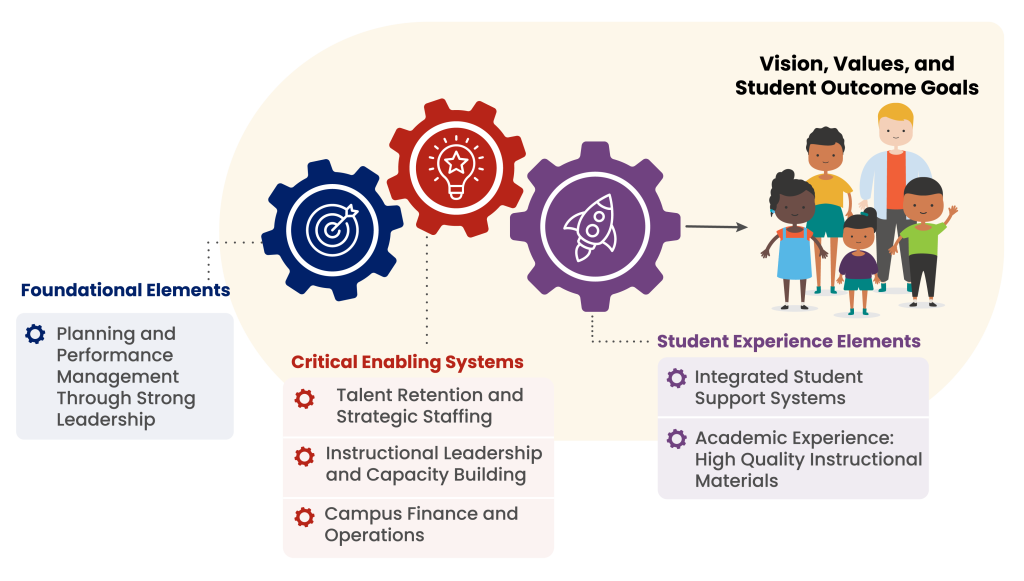
The impact model categorizes each of the Levers into one of the three components. It illustrates how all systems work together. If one cog stops, the others halt; if one speeds up, the other are impacted as well. The same is true of campus systems and practices.
The Six ESF Levers
- Lever 1 – Planning and Performance Mangement through Strong Leadership. Lever 1 focuses on the vision for student success, the campus’ strategic plan for improvement, and project management for prioritized district initiatives.
- Lever 2 – Talent Retention and Strategic Staffing. Lever 2 highlights the intentionality behind staff selection, placement, growth, and retention strategies.
- Lever 3 – Integrated Student Support Systems. Lever 3 emphasizes the implementation of the district’s Multi-Tiered Systems of Support (MTSS). Additionally, school-wide culture, behavior, safety, and student interventions and supports are foundational in this Lever.
- Lever 4 – Academic Experience: High Quality Instructional Materials (HQIM). Lever 4 ensures the implementation of strong, multi-tiered curriculum, instruction, and supports. This Lever also includes providing students access to College, Career, and Military Preparation (CCMP) course offerings and graduation programs of study.
- Lever 5 – Instructional Leadership and Capacity Building. Lever 5 establishes expectations around campus systems for instructional leadership and coaching, job-embedded support for effective classroom instruction, and the utilization of data to support all learners.
- Lever 6 – Campus Finance and Operations. Lever 6 pinpoints best practices for allocating time during the school day, budgeting, the process for enrollment and recruitment, and resource alignment to support the envisioned student experience.
ESF Lever Functions
The ESF Essential Actions describe what the most effective schools do to support powerful teaching and learning. These also help build a common language around high-leverage best practices across the state.
Each Essential Action contains a set of Key Practices, which detail specific systems and practices campuses should have in place for each Essential Action.
The Success Criteria, in the format of a rubric, exists for the 20 diagnosed Key Practices. There are two types of rubrics – System Design and System Implementation. The System Design rubric evaluates if a campus has the structures, expectations, and tools needed to support the campus. The System Implementation rubric evaluates how consistently and effectively a school district implements systems across the campus, focused on execution and not solely intent or documentation. Success Criteria describe what the Key Practices look and sound like when implemented with fidelity. When designing and implementing systems and practices, campuses can use the Success Criteria to determine alignment.
Resources
The ESC Region 13 Effective School Framework team is ready and available to provide training and support to districts and campuses seeking to learn more about the ESF 4.0. Visit our website for the latest professional development opportunities. Subscribe to our emails for up-to-the minute information. We are here to help. Reach out to our team with questions.

Tai Choice
Tai Choice is the ESC Region 13 Effective School Framework Coordinator.



Add comment