
Between turning state learning standards into active discovery, embedding Individualized Education Program (IEP) goals into everyday play, and keeping learning genuinely hands-on and developmentally appropriate, adding another framework can feel overwhelming. But the Pyramid Model, supported by the National Center for Pyramid Model Innovations (NCPMI), isn’t about starting from scratch. It provides a framework for understanding, strengthening, and building upon many of the practices early childhood educators already use throughout the day.
While the framework may seem like a lot to unpack, many of its foundational practices are already part of the early childhood classroom routine. Let’s explore each tier and how current classroom practices and procedures can become part of a more intentional approach to supporting children’s social-emotional development.
Building on the Foundation
You’re already building the foundation and applying the framework each day. The Pyramid Model helps you strengthen it and understand when and how to provide additional support.
At the heart of the Pyramid Model is a strong core built on nurturing, responsive relationships and high-quality, supportive environments. These everyday practices help children feel safe, connected, and ready to learn.
The model organizes practices into three tiers of support:
- universal practices that benefit all children,
- targeted social-emotional supports for some children, and
- intensive, individualized interventions for the few who need them.
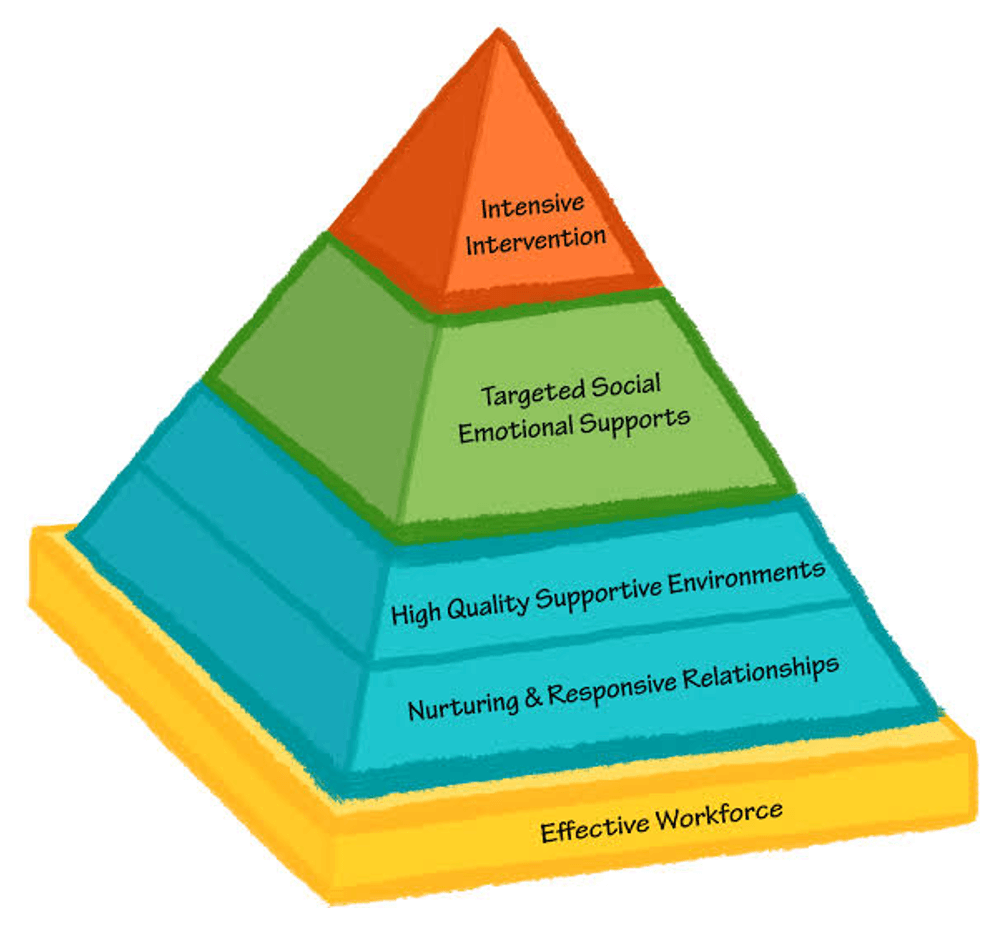
The shape of the pyramid reminds us that strong foundational practices support the needs of most children. Additional layers of support are available when needed.
Just as importantly, the model recognizes that educators need support, too. Effective leadership, ongoing coaching, and attention to staff well-being help teachers implement and sustain these practices over time.
Tier I: Building the Base with Relationships and Environment
The Pyramid Model begins with two essential practices: nurturing and responsive relationships, and high-quality supportive environments.
Relationships: Positive, responsive relationships allow children to feel safe, valued, and connected. Through consistent, caring interactions, educators can build trust, nurture children’s social-emotional development, and create connections that help children feel secure and ready to learn.
Environments: Well-designed, predictable, and engaging classroom environments enable children to understand expectations, navigate routines, and participate successfully. Thoughtful arrangements of space, materials, schedules, and transitions can promote independence, encourage positive interactions, and prevent challenging behaviors before they occur.
Together, these practices create conditions in which children can thrive. Next, let’s talk through the three Tiers, and give a few examples of what it could look like in action.
Pyramid Model Tier I in Action:
- Greeting all students at eye level: Welcoming children with high-fives, waves, or warm greetings right at the doorway each morning.
- Framing expectations positively: Reminding children to use “walking feet” instead of saying “stop running,” or “safe hands” instead of “don’t hit.”
- Utilizing visual schedules and cues: Providing pictures, objects, or other visual supports that help children understand routines, expectations, and what comes next.
- Creating quiet reset spaces: Offering a “Calm Corner” stocked with soft cushions, fidgets, and/or visual supports where children can choose to take a break, with adult assistance as needed.
- Teaching social-emotional skills throughout the day: Modeling friendship skills, talking about emotions during stories, and helping children practice problem-solving during play.
Tier II: Teaching Social-Emotional Skills Explicitly
While Tier I provides a strong foundation for all children, Tier II offers targeted social-emotional instruction for children who need additional reinforcement and instruction in emotional literacy, friendship skills, problem-solving, and emotional regulation. These skills are explicitly taught through modeling, guided practice, and repeated opportunities to use them throughout the day.
You may recognize many of these practices as part of developmentally appropriate instruction for all young children, and you’re right! The difference at Tier II is that children receive additional, intentional instruction and practice beyond what is provided universally.
Pyramid Model Tier II in Action:
- Building Emotional Literacy: Providing additional, targeted opportunities to help children recognize and name emotions by describing observable cues and introducing feeling words. For example, “I see you’re crying. Are you feeling sad?” or “Your tower fell. Sometimes that can feel frustrating. How are you feeling?”
- Teaching friendship skills: Working with a small group of children who have difficulty joining peer play. The teacher may model ways to enter play, provides opportunities to practice with puppets or role-playing, and supports children in using these skills during learning centers.
- Teaching Problem-Solving Skills: Helping children learn specific steps for resolving social conflicts. Teachers might introduce visual problem-solving steps, model possible solutions using puppets or familiar scenarios, and provide repeated opportunities for children to practice choosing and trying solutions.
- Teaching Emotional Regulation: Providing targeted instruction to help children recognize when they are becoming upset and learn strategies for managing strong emotions. For example, teachers might use NCPMI’s Tucker the Turtle to explicitly teach children to stop, tuck into their shell, take deep breaths, and think of a solution, followed by guided practice and support using the strategy in real situations.
These targeted supports are in addition to, not in place of, the universal instruction available to every child.
Tier III: Responding to Challenging Behavior
Even when universal and targeted instruction is strong, there still may be children who need more intensive, individualized intervention. Although many behaviors may be the same you see in all children in your classroom, what makes intensive intervention necessary in the severity, intensity or persistence of a behavior. At Tier III, the focus shifts from selecting individual strategies to understanding the purpose of a child’s behavior. Then developing a comprehensive, individualized behavior support plan.
At this level, educators work with families and other professionals to better understand the function, or purpose, of challenging behaviors. They teach new skills, address specific needs, and help children participant successfully throughout the day by creating individualized behavior support plans.
Pyramid Model Tier III in Action:
- Working Together as a Team: Families, teachers, and other professionals come together to share what they know about the child, discuss concerns, and identify goals that will help the child be successful.
- Looking at “Why” the Behavior is Happening: Rather than focusing only on what a child is doing, the team looks at when and why the behavior occurs. What happens before the behavior? What happens afterward? What might the child be trying to communicate? Observations and information from families help the team better understand the behavior’s purpose.
- Creating a Support Plan: Once the team understands the likely function of the behavior, they develop a plan that includes ways to prevent challenging situations, teach new skills, and respond consistently when challenging behavior occurs.
- Putting the Plan into Practice: The team uses the plan during everyday routines, monitors how the child responds, and makes adjustments based on what is or isn’t working.
For example, imagine a child who frequently hits peers when it’s time to clean up. Rather than simply responding to the hitting, the team works to understand what the child may be communicating. They might discover that ending an activity they are really enjoying is particularly difficult. With that information, they can adjust the transition, teach the child a way to request more time or help, and monitor whether the new supports are making a difference.
From Building Blocks to a Complete Framework
The Pyramid Model isn’t about starting from scratch. It’s about recognizing the great things early childhood educators are already doing and building on those strengths with greater intention. Every positive interaction, predictable routine, and opportunity to teach social-emotional skills helps create a strong foundation. And when children need additional support, the Pyramid Model provides a framework for knowing what to do next.
Let’s Keep Building Together!
The Early Childhood Education team at ESC Region 13 is here to support you! Contact us with questions or issues. Visit our website to see the latest in professional development, services, resources, and more. Subscribe to our newsletter to stay up-to-date.
References:
National Center for Pyramid Model Innovations. (n.d.), The Pyramid Model graphic [Infographic]. University of South Florida. https://www.challengingbehavior.org/document/the-pyramid-model-graphic/

Maryteresa Tracy is the Early Childhood Education (ECE) Program Manager at ESC Region 13.

Angelica Lopez
Angelica Lopez is the Early Childhood Specialist at ESC Region 13.



Add comment