

Spring is the time of year when testing rosters are being finalized. Questions about which students count for the A-F Accountability come flooding into coordinators’ inboxes. So many of those questions lie in a simple concept that drives what gets scored on your report and what doesn’t: the accountability subset.
Understanding this subset isn’t just a technical detail. It affects performance results, domain scores, and distinction designations. Ultimately, the narrative you’ll tell about your school or district this spring. This article explores the accountability subset, what counts, what doesn’t, and why it matters.
What exactly is the accountability subset?
In the simplest terms, the accountability subset is the group of students whose assessment results count toward your yearly* accountability scores.
For STAAR-based results, which drive the Academic Achievement, School Progress, and Closing the Gaps domains, only assessment results from students who were enrolled on the same campus in the fall and then tested on that same campus count in the subset.
That enrollment is captured on the Texas Student Data System (TSDS) Public Education Information Management. System (PEIMS) October snapshot. If a student wasn’t enrolled on that snapshot date and on the same campus at testing, their score is not included in your accountability calculations.
What counts in the accountability subset?
Here are the key things that count for yearly accountability*:
- Students who were enrolled on your campus or district on the October snapshot date and are tested on that same campus during the accountability year, typically during the fall or spring assessment cycles.
- For end-of-course tests, summer results from the prior year are included, subject to best results selection rules, if the student was enrolled in the snapshot period of that prior year.
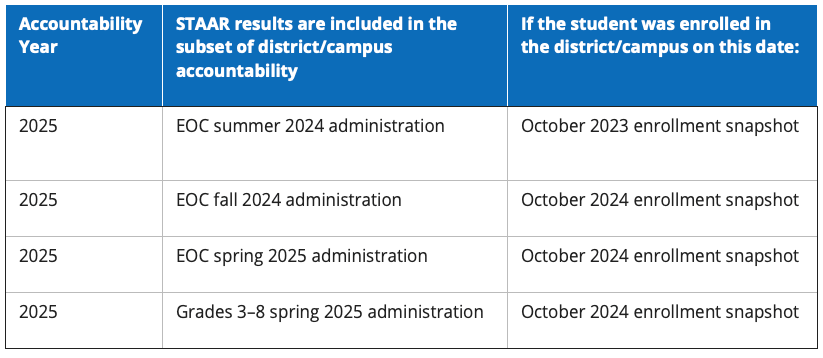
These rules help ensure that schools and districts are evaluated on the students they serve throughout the year. Not students who joined the district right before tests or after they spent most of the school year elsewhere.
What doesn’t count in the accountability subset?
Keeping track of what doesn’t count in the accountability subset can be just as important. Especially when you are preparing the correct rosters.
Here are key things that do not count for yearly accountability*:
- Students who enroll after the October snapshot and test on your campus do not count in your accountability subset.
- Students who transfer out after the snapshot and then test on another campus or district are removed from your accountability computation.
That’s why you might see a student in your test results but not in your accountability rates. Their assessment exists, but it isn’t included in the subset for rating calculations.
Why this matters for spring testing rosters
Accountability subset questions surge right before spring testing rosters are finalized. That’s not an accident.
Your fall snapshot enrollment feeds directly into which results count later. If a student is not in the subset, their STAAR performance won’t influence domain scores or distinction labels. That can affect your Domain 1 performance rates, Domain 2 progress formulas, and even the Closing the Gaps results.
Being clear on who’s in your subset helps you do the following:
- Forecast your accountability outcomes using current data.
- Review your testing rosters with an eye toward the students whose results will count.
- Communicate with teachers and leaders about why certain students’ results aren’t showing up in your accountability summaries.
In tight accountability situations, think small groups, high-mobility campuses, or critical distinction indicators. Understanding the subset can make the difference between surprises and strategic action.
Accountability Subset Frequently Asked Questions
Does every student who tests count for accountability?
No. Not every student who takes a STAAR assessment is included in accountability calculations. Only students who meet the accountability subset enrollment rules are used to calculate ratings and domain results.
Why do I see a student in my test reports but not in accountability data?
Assessment reports show all students who tested. Accountability reports only include students in the accountability subset. If a student enrolled after the October snapshot or tested on a campus other than the one where they were enrolled in the fall, their results may appear in testing reports but not in accountability calculations.
If a student transfers to my campus after the snapshot, do their results ever count?
No. If a student enrolls after the October snapshot date, their STAAR results will not be included in your accountability subset, even if they test on your campus in the spring.
What about students who move during the year?
If a student was enrolled on your campus on the October snapshot date but transfers out before testing, their results will not count for your campus if they test elsewhere. Accountability follows snapshot enrollment and testing location together.
Do summer end-of-course results count?
Yes, in certain cases. Summer end-of-course results from the prior year can be included if the student was enrolled during the appropriate snapshot period for that accountability cycle.
Does the accountability subset apply to all domains?
The accountability subset primarily affects STAAR-based indicators used in the Academic Achievement and School Progress domains. Other components, such as graduation rates, follow different inclusion rules.
Conclusion
The accountability subset isn’t arbitrary. It’s designed to focus the A-F system on students who were genuinely part of a campus or district’s instructional program for the year. It removes the noise that comes from late arrivals and early leavers, so your ratings reflect who you were responsible for educating.
If the accountability subset still feels like a mystery after rostering season, lean on your ESC accountability specialist for more answers. Getting clarity will pay dividends when preliminary reports are available during the year.
The accountability specialists at ESC Region 13 are always available to answer questions and help you. Subscribe to our newsletter for updates, news, and the most current information on the A–F Accountability system. Visit our webpage for the latest professional development opportunities and downloadable resources or to connect with us. For more articles on a wide range of accountability topics, visit the ESC Region 13 blog.
* This blog was written in March 2025.

Rick is an Administrative Specialist of Data Systems and Accountability here at the Education Service Center Region 13.



Add comment